Hackers could potentially spy on a computer screen without touching the device or installing malware.
Research shows that electromagnetic signals leaking from HDMI connections can reveal displayed content, while artificial intelligence can make intercepted text easier to read.
A video posted on X by @Psalteric on 8 November 2026 renewed interest in the technique. It shows a distorted reconstruction of screen content, not an AI-enhanced image. Separate research from Uruguay demonstrates what AI can improve.
How Can an HDMI Cable Reveal Your Screen?
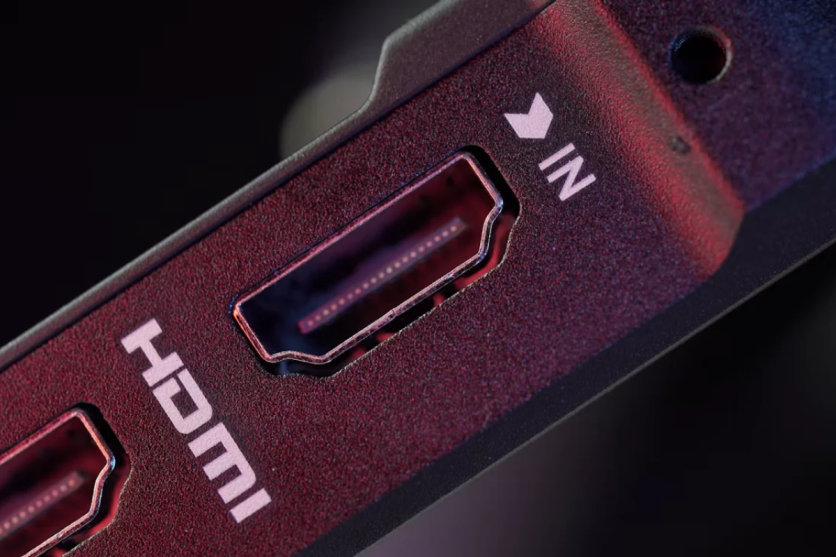
HDMI cables transmit digital video between computers and monitors. However, cables and connectors can unintentionally emit electromagnetic signals that specialised equipment may detect.
According to the November post, the demonstration uses TempestSDR.
your HDMI cable can leak what’s on your screen
— Psalter (@Psalteric) November 8, 2026
watch the laptop on the left. it reconstructs the video playing on the monitor beside it from radio signals leaking out of the HDMI connection
this is TempestSDR. an antenna picks up the leakage, a HackRF radio captures it, and… pic.twitter.com/T7ivqBtPs6
An antenna picks up the emissions, a HackRF radio captures them, and software reconstructs an image resembling the original display.
The recovered picture is distorted, although some content remains recognisable. The technique does not require malware, stolen passwords or access to the computer's operating system.
Known as TEMPEST, electromagnetic information leakage has been studied for decades. Digital video signals are harder to reconstruct than older analogue signals, but interception remains possible under suitable conditions.
How Does AI Make Intercepted Text Easier to Read?
Researchers at Uruguay's Universidad de la República developed Deep-TEMPEST, which uses deep learning to improve images reconstructed from electromagnetic emissions.
Their study, first released in July 2024 and subsequently published in conference proceedings that year, tested whether AI could improve text recovered from HDMI signals.
In controlled tests, conventional gr-tempest software produced a character error rate of 92.2%. A Deep-TEMPEST model trained on real captures reduced that to 35.3%, while a model fine-tuned using simulated and real data achieved 29.8%.
These figures compare text recognised in reconstructed images against text recognised in originals. They do not measure how much private information an attacker could steal.
The researchers used 1,302 real captures alongside simulated data. They also released their code and dataset for others to examine.
Could Hackers Read Passwords or Private Messages?
Potentially, if sensitive information appears on screen and intercepted emissions contain enough recoverable detail. That could include visible emails, messages or passwords.
An attacker would need appropriate receiving equipment, signal-processing software and a location where emissions are detectable. Distance, interference, shielding and display configuration all affect the results.
The researchers found that changing screen resolution significantly reduced their model's performance in one test. They did not establish that criminals routinely use Deep-TEMPEST against home computers.
Conventional antivirus software would not necessarily detect passive electromagnetic monitoring because no software intrusion is required.
Should You Replace Your HDMI Cable?
For most users, the findings do not justify replacing a functioning HDMI cable. Better shielding may reduce leakage, but a higher price does not guarantee protection.
Importantly, the November clip demonstrates TempestSDR, not Deep-TEMPEST's AI-enhanced reconstruction. It cannot be used to judge the AI model's performance.
Organisations handling sensitive information may consider specialist shielding, equipment separation and electromagnetic-security assessments.
Researchers also tested subtle changes to displayed images that disrupted AI reconstruction, although these remain experimental protections.
The findings highlight a security risk beyond traditional hacking. Sensitive information can leak through physical signals, even when a computer's software has not been compromised.
Frequently Asked Questions
- What is electromagnetic signal leakage?It is the unintentional emission of electromagnetic signals from electronic devices, which can potentially be intercepted.
- Can AI improve the readability of intercepted signals?Yes, AI can enhance the readability of intercepted signals by reducing character error rates in reconstructed images.
- Should I replace my HDMI cable to prevent leakage?For most users, replacing a functioning HDMI cable is not necessary, but better shielding may reduce leakage.


