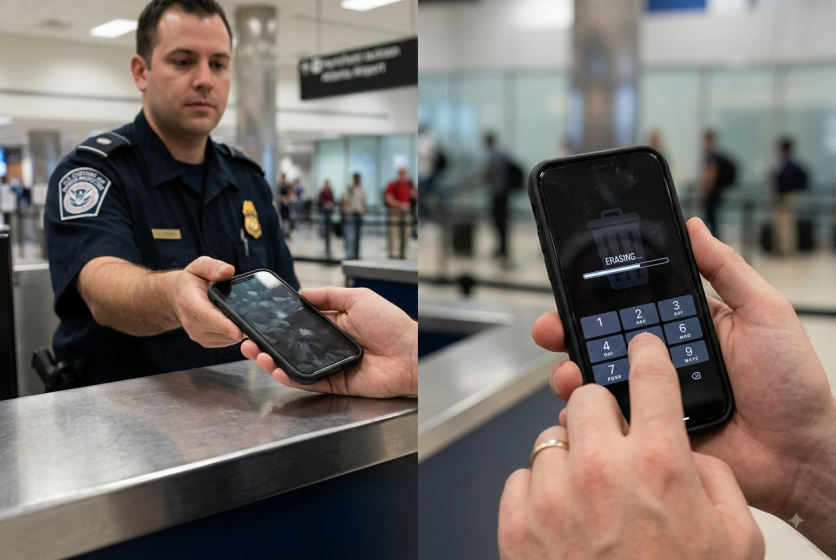
Federal authorities in Atlanta have filed obstruction charges against an American citizen who handed customs officers a 'duress' passcode, triggering a security feature that wiped his device clean.
When Samuel Tunick, an Atlanta resident, flew back to the United States on 24 January last year, officials held him for questioning at Hartsfield-Jackson Atlanta International Airport, according to a grand jury indictment from November. Border agents confiscated his phone before allowing him to enter the country, setting the stage for a federal court hearing in Atlanta last week.
Federal authorities have taken the unusual step of treating phone-erasing software as evidence destruction, bringing charges in a case involving a secret passcode designed to trigger a total wipe.
At last week's hearing, defence attorneys countered that the initial seizure was illegal, claiming authorities singled out Tunick over his involvement in protests against a proposed police and fire training facility – a project critics dub 'Cop City' over concerns that it will militarise local law enforcement and devastate local woodland.
Legal Framework of the Obstruction Charge
The underlying federal law penalises anyone who destroys property to avoid lawful government seizure, or alerts others to an impending search. Violations are punishable by up to five years in prison, substantial fines, or both.
Legal experts point out that the law can apply at any point around a valid search, meaning anyone who anticipates an impending seizure and acts to prevent it can face prosecution.
Legal Grounds for Digital Data Seizure
Viewing digital data as property, wiping a device can be considered as destroying tangible evidence. Federal prosecutors contend the smartphone was merely a vessel holding property they had lawful authority to seize, making the use of the duress code an intentional act of destruction.
'The statute says explicitly it has to be for the purpose of preventing or impairing the government's lawful authority,' said Daniel Richman, a law professor at Columbia University and a former prosecutor in the U.S. Attorney's Office.
'The key is he gave the code to the government, knowing that the entry of this code would erase the evidence,' Richman added.
Border Search Context Core to Legal Battle
The border setting is pivotal to both sides. Border authorities assert they can inspect incoming travellers' devices without warrants, holding that constitutional limits do not fully apply before official entry.
Returning from the Dominican Republic, Tunick and his legal team counter that basic rights remain intact even at airport checkpoints, pointing out that he was unlawfully detained, denied access to counsel and never read his rights.
How Duress Passcodes Reset Mobile Devices
A duress passcode acts as a protective security feature, allowing users to configure a secondary code distinct from their main lock-screen PIN. If coerced into unlocking their phone, a user can enter this alternate code to trigger a complete system wipe rather than granting access.
A phone passcode could become a five-year federal prison sentence. One activist says the government is trying to scare people out of protecting their data.
— Link Technologies (@LinkTechnlogies) July 29, 2026
Samuel Tunick was charged after his GrapheneOS phone allegedly wiped itself before officers could search it. He argues the… pic.twitter.com/5WFcqxk1QT
The operating system erases all underlying digital data in seconds while leaving the hardware undamaged. In this case, Tunick ran GrapheneOS, a privacy-focused, Android-compatible operating system featuring this capability.
Why Timing Proves Critical in Obstruction Charges
Professor Richman noted that erasing data before reaching a checkpoint – simply to preserve personal privacy – argues strongly against an intentional attempt to obstruct an imminent investigation. However, the legal threshold changes once formal questioning begins.
'Intentionally giving a wipe code to people you know to be exercising lawful authority is going to put you squarely in the realm of the statute,' he said.


