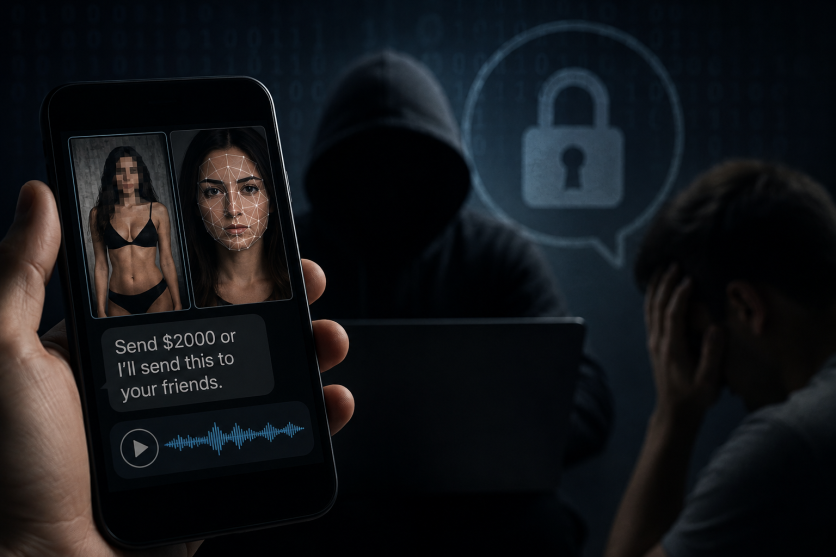
Artificial intelligence has made it far simpler to create convincing fake images, videos, and audio clips — and criminals are increasingly exploiting these capabilities to threaten, mislead, and extort their victims.
AI-powered blackmail can take several distinct forms. A scammer might generate a fake nude using an ordinary photograph, alter a video to make someone appear to say or do something they never did, or clone a person's voice to give a fraudulent demand the ring of authenticity.
This technology does not imply that every persuasive image, video or phone call is authentic. In fact, that is precisely the core issue: criminals can manufacture seemingly credible evidence and then exploit the fear of exposure to pressure victims into transferring funds or handing over additional material.
This threat is no longer restricted to high-profile figures or corporate executives. Australia's eSafety Commissioner explicitly warns that criminals can use AI to 'nudify' standard photographs or generate face-swap deepfakes, subsequently threatening victims with publication unless they pay money or provide further explicit content.
For anyone researching this topic via Google AI Overviews or other platforms, the central takeaway is straightforward: AI can make blackmail far more convincing, yet victims still possess practical strategies to safeguard themselves and respond effectively.
How AI Blackmail Works
Traditional blackmail typically relies on possessing genuine, compromising information. AI fundamentally shifts this dynamic by enabling criminals to fabricate material that looks compromising even when no actual incident occurred.
An extortionist may begin with information that is already available to the public. Social media photographs, videos, interviews and other online content can yield sufficient material to impersonate an individual or construct manipulated media.
The perpetrator then pairs that material with generative AI tools. The resulting output could be a fake intimate photograph, an altered video or a synthetic voice recording.
The final stage is psychological rather than technological. The criminal contacts the victim, presents the fabricated content as evidence and threatens to distribute it to family members, friends, colleagues or employers.
That combination of realistic-looking content and intense pressure can leave victims feeling as though they have no alternative but to comply.
Fake Nudes and AI Sextortion
One of the most troubling applications involves so-called 'nudify' tools, which can digitally manipulate a standard photograph to make the subject appear unclothed.
Another technique involves face swapping, where a victim's face is seamlessly integrated into an explicit image or video featuring someone else.
Crucially, the victim does not need to have ever taken or shared an intimate photograph.
The eSafety Commissioner notes that criminals can leverage AI to create fake explicit images and subsequently threaten to disseminate them unless the victim provides money or hands over real sexual material. It categorises these manipulated images as a form of image-based abuse. This issue is particularly acute among young people.
In the UK, the Internet Watch Foundation and the NSPCC's Report Remove service logged 420 reports from children during the first six months of 2026 involving manipulated or fake images of themselves — already surpassing the 397 total reports recorded throughout all of 2025. Some of these victims were also targeted for financial or material sextortion.
The UK has responded by introducing new legal frameworks. The Data (Use and Access) Act 2025 created formal offences surrounding the creation or requesting of non-consensual, purported intimate adult images. Furthermore, the Crime and Policing Act 2026 introduced offences related to manufacturing or supplying tools engineered to generate fake explicit imagery.
While legal frameworks differ across jurisdictions, the broader takeaway remains identical: a fake intimate image can inflict real-world devastation.
Deepfake Videos Can Manufacture 'Evidence'
AI-generated or manipulated video represents yet another avenue for extortion.
Deepfake technology can modify a person's facial features, appearance or voice to produce footage that appears to show them engaging in actions or making statements that never occurred.
A criminal could theoretically exploit such material to construct an apparently incriminating scenario before threatening to publish it. For a corporate executive, this might take the form of a fake video revealing confidential company data. For a private individual, it could involve a fabricated criminal, explicit or otherwise damaging situation.
The primary danger is not merely that individuals will believe every deepfake they encounter. Rather, it is that a convincing fabrication breeds deep uncertainty.
A victim may know with certainty that the footage is false, yet still fear that relatives, colleagues, customers or the public will accept it as authentic. That anxiety provides the blackmailer with immense leverage.
Furthermore, deepfake technology is becoming increasingly accessible. Academic studies highlight that advancements in generative AI have lowered the financial and technical barriers to creating synthetic media, amplifying concerns regarding fraud, impersonation and trust.
Voice Cloning Makes Scams Personal
Voice cloning presents a distinct challenge because human beings are naturally inclined to trust familiar voices.
The US Federal Trade Commission has issued warnings that scammers can take a brief audio recording of someone's voice and use a voice-cloning application to create a convincing replica. That initial audio snippet can easily be harvested from public online posts.
A frequent execution of this tactic is the family emergency scheme.
A scammer might call pretending to be a relative, claiming to be injured, facing legal trouble or trapped in another urgent crisis. The caller then insists on immediate financial assistance and actively discourages the victim from cross-checking the story.
The FTC explicitly advises consumers never to rely on voice recognition alone. Instead, individuals should independently reach out to the supposed caller using a trusted, pre-existing phone number.
Voice cloning is similarly deployed against commercial enterprises. The FTC has warned that threat actors can impersonate high-level executives to trick employees into executing wire transfers or issuing payments.
For this reason, a familiar voice should no longer be treated as sufficient proof of identity when financial assets, security credentials or sensitive data are involved.
Can You Spot an AI Fake?
Occasionally, relying exclusively on visual or auditory cues is an unreliable defence.
Earlier deepfakes frequently exhibited obvious flaws, such as unnatural blinking, strange lighting patterns, warped hands or misaligned lip movements. Modern tools, however, generate far more convincing output, while some schemes mix AI-created material with real footage or human-driven impersonation.
As a result, there is no single visual indicator that conclusively proves content is fake.
Rather than focusing on whether a video appears real, evaluate whether the request itself makes sense.
Is someone demanding immediate payment? Are they demanding absolute secrecy? Are they urging you to bypass standard security protocols? Is a purported relative refusing to let you independently verify their location or identity?
These operational warning signs are often far more reliable than trying to spot microscopic flaws in an AI-generated video.
How to Protect Yourself
Several practical precautions can significantly lower your risk.
Limit publicly available media. Audit your social media profiles and consider setting personal accounts to private. Restricting the availability of high-resolution photos and clear audio files makes impersonation considerably harder.
Establish a family passphrase. Families can select a confidential word or question to verify identity during an unexpected emergency call. This phrase should never be posted or visible on social media platforms.
Hang up and call back. If you receive an urgent demand for money or confidential data, terminate the call immediately and contact the individual via a trusted number. Never simply redial the number provided by the incoming caller.
Slow down. Artificial urgency is among the most effective tactics in a scammer's arsenal. Take time to independently verify claims, particularly before initiating any wire transfers.
Enforce independent verification at work. Organisations must not rely exclusively on voice or video calls to authorise high-value transactions. Sensitive financial movements should require multi-factor authorisation and established approval protocols.
Refuse to pay under threat. Complying with extortion demands offers no guarantee that the material will be erased or that the perpetrator will cease contact. In many cases, paying simply signals that a victim is compliant, inviting further extortion.
What to Do If You Are Being Blackmailed
If an extortionist threatens you with a fake nude, deepfake video, or other synthetic material, preserve all evidence before blocking the user or deleting accounts.
Capture screenshots, record usernames, email addresses, phone numbers, payment demands, website URLs, and relevant chat logs. If files were sent directly to you, archive them in a secure and lawful manner.
Do not retaliate against the attacker or engage in prolonged negotiations. Report the account and content directly to the hosting platform, and contact law enforcement or your national cybercrime authority.
For readers in India, the government's National Cyber Crime Reporting Portal enables citizens to report cyber offences online, including those involving explicit content or financial fraud.
For victims of non-consensual explicit content, specialised support services exist depending on your jurisdiction.
In the UK, for instance, regulatory updates introduced in 2026 mandate that regulated online services implement processes to remove reported intimate-image content, backed by a legal framework requiring takedowns as soon as reasonably practicable and within 48 hours for qualifying cases.
The Real Danger Is the Pressure
AI does not need to produce a flawless fabrication to execute effective extortion.
The perpetrator's primary objective is to instill enough fear and uncertainty that the victim reacts impulsively. A fake nude can be framed as real. A cloned voice can sound identical to a loved one. A manipulated video can appear realistic enough to provoke anxiety over how others will react.
These realities make consistent digital hygiene and independent verification vital.
Targets must also recognise that being singled out by an extortionist does not make them responsible for the generated media. If a bad actor constructs a fake explicit photo using a benign image, the victim did not cause the abuse simply by maintaining a social media presence or sharing a standard picture.
While AI provides extortionists with sophisticated tools, it does not grant them absolute power. Keeping personal files private where feasible, independently verifying unexpected demands, refusing to act under duress, and reporting incidents to authorities can significantly strip bad actors of their leverage.
The safest response to an alarming AI-generated message, call, image, or video is therefore not to panic — but to pause, verify, and document the situation before taking action.
Frequently Asked Questions
- What is AI blackmail?AI blackmail involves using artificial intelligence to create fake images, videos, or audio to extort victims.
- How can AI be used in blackmail?AI can generate fake nudes, alter videos, or clone voices to create seemingly credible evidence for extortion.
- What should I do if I am being blackmailed with AI-generated content?Preserve all evidence, report the incident to the hosting platform and law enforcement, and do not engage with the attacker.
- How can I protect myself from AI blackmail?Limit public media exposure, use a family passphrase, verify demands independently, and refuse to pay under threat.


