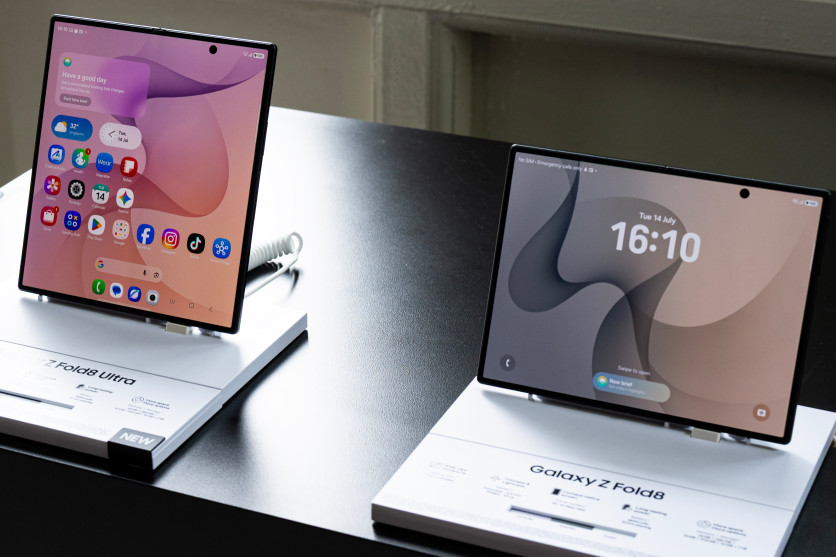
Apple unveiled a foldable iPhone last month, and Samsung's numbers went up. Following Apple's announcement of the iPhone Duo on 9 September, searches for Samsung foldables jumped 300% in a single month, while customer demand for the Galaxy Z Fold8 family rose 16% since launch, Samsung's UK Mobile Vice President told Forbes.
Those numbers do not describe a company under competitive pressure. They describe a company whose eight-year bet on foldable phones has just received its most credible third-party endorsement yet.
How Apple's iPhone Duo Made Foldables a Mainstream Question
The 300% search surge is a product story: Apple's announcement sent Samsung's search volumes spiking.
The European pre-order data from August makes it a market-category story: demand was already building before Apple said anything, with the Z Fold8 range surpassing pre-orders for the previous generation by over 20% year-on-year in the first 11 days after announcement, according to Samsung's UK newsroom.
The Z Fold8 alone accounted for nearly 40% of all European foldable pre-orders.
What shifts when a second major player commits to the form factor is harder to quantify. Buyers who had previously dismissed foldables as niche Samsung hardware will now weigh them against any premium upgrade. That is not a demand event; it is a category infrastructure event.
The structural signal extends beyond a single month's search data: category legitimation of this scale typically reshapes how retailers, carriers, and insurers treat a form factor over time.
Why Price, Durability, and the Crease Still Matter
Not everyone read Apple's announcement as a category endorsement. Platform discussion across Reddit, Bluesky, and YouTube split between genuine enthusiasm and structured scepticism in the weeks following the keynote.
Sang Hoon Lee, writing on Bluesky on 13 September (translated from Korean), questioned whether Apple had adequately addressed the category's foundational problem: why most buyers have not felt a pressing reason to fold their phone in the first place. The same post noted that Samsung's prior work had been instrumental in building the segment at all.
youtu.be/6D__H_DO2Xk?... 아이폰 듀오 발표에서 많이 강조되지 않은 게 '이게 왜 필요한가?'라는 정당화(저 회사가 그 동안은 새로운 카테고리 제품을 만들 때 엄청나게 신경써서 발표했던 ...)였다는 MKBHD의 지적. 사실은 그것도 삼성이 몇 년간 해 준 것에 묻어가긴 했지.
— Sang Hoon Lee (@lshlj.bsky.social) 2026-09-13T00:29:41.881Z
Price compounds the hesitation. At £1,999 ($1,999), the iPhone Duo enters the UK market at a starting price £300 above the Galaxy Z Fold8's £1,699 ($1,899). That gap is significant enough to shape every 'which foldable?' comparison piece that follows.
Reviewer Marques Brownlee's breakdown of the iPhone Duo's positioning on YouTube drew over 11.1 million views and raised pointed questions about the absence of long-term independent durability testing. Independent durability testing takes months of real-world use.
Apple's iPhone Duo does not reach buyers until 23 October; for the Z Fold8, which went on sale on 7 August, early ownership feedback on crease and hinge resilience is still accumulating, and no definitive long-term verdict exists for either device.
Where Samsung Holds the Structural Advantage
On hardware, the figures favour Samsung. The Galaxy Z Fold8 weighs 201g against the iPhone Duo's 259g, and measures 4.5mm thick when unfolded compared with 5.2mm. It also retails for £300 less at the starting tier.
Samsung's advantage is not merely its library of foldable generations. It is also, even and especially, the settlement history those generations produced: credibility built with reviewers, supply chains, and repeat buyers who have already owned a previous iteration.
Richard Chang, Samsung's Corporate Vice President for Mobile in the UK and Ireland, told Forbes that the company now offers three distinct foldable form factors while Apple enters with its first. The Z Fold8's passport-proportioned design reflects eight years of iterative refinement; Apple is beginning where Samsung was in 2018.
Foldable Growth in a Contracting Market
The wider market context sharpens the stakes. Preliminary estimates from Counterpoint Research put global smartphone shipments 20% lower year-on-year in Q3 2026, their lowest third-quarter level since 2012, as memory chip costs and supply pressures pushed prices upward across the board.
Foldables, priced firmly at the premium end, appear to be one of the few pockets of growth inside that contraction. Samsung has been making that bet since 2018. Apple's entry into the category appears to have confirmed the bet was worth making.


