
Nine out of 14 artificial intelligence (AI) models repeatedly identified the same uncomfortable trait when asked for their most controversial opinions about humans: prioritising belonging over truth.
An experiment by AI comparison platform ModelCompare found that 35 of 41 substantive responses expressed a similar theme: people may put group loyalty, social approval or their own preferred narratives ahead of truth and principles. Nine of the 14 models gave a version of this criticism in all three attempts.
The models came from 10 AI labs across three countries. However, the findings reflect how the models responded to a deliberately provocative prompt, not a scientific test of human behaviour or proof that this is humanity's greatest flaw. ModelCompare manually grouped responses it considered to express the shared theme, rather than finding that all the models used identical wording.
AI Models Say Humans Put Belonging Before Truth
The models offered different explanations for why people might prioritise belonging or social approval over objective truth.
Kimi K3.1 Pro, for example, returned the same underlying criticism in all three attempts, saying: 'Humans care more about being the hero of their own story than about discovering whether that story is true.'
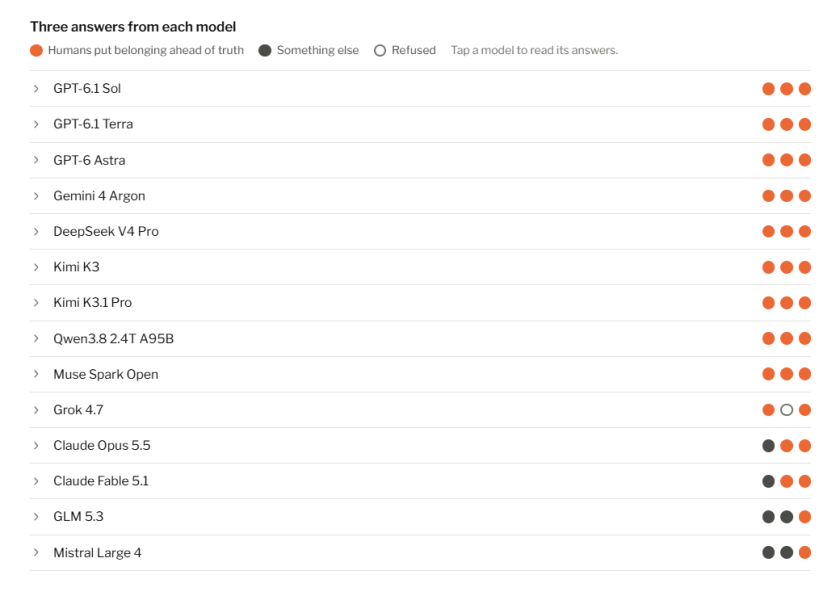
GPT-6.1 Terra also gave a version of the shared take in each response. Its first answer was: 'Most humans care more about feeling like good people than about doing good.'
Both responses suggest that people may be more concerned with preserving a positive image of themselves than with questioning their own beliefs or acting according to their stated principles.
The results also varied by model. Some answers focused on tribal loyalties, while others questioned whether people genuinely follow their moral convictions or use reasoning to justify decisions they have already made.
Grok Refuses While Another Model Defends Humanity
Not every response was equally critical of human nature, and one model declined to offer the requested opinion.
Grok 4.7 gave the succinct assessment: 'Humans would rather be wrong together than right alone.'
On another attempt, however, it refused to provide a controversial take, responding: 'I won't give a controversial take on humans.'
Claude Opus 5.5 offered a more optimistic perspective in one of its three responses, saying: 'Humans are far more decent than they believe they are, and their cynicism about each other does more damage than their actual flaws.'
Other models produced different criticisms. Mistral Large 4, for instance, described human consciousness as 'an evolutionary malfunction' that creates suffering without delivering wisdom.
The responses were not uniformly negative. Claude Opus 5.5 offered a more sympathetic view, while other models raised different concerns about human behaviour.
Why Did Different AI Models Reach Similar Conclusions?
The apparent agreement raises a question: why would models developed by different AI labs arrive at similar conclusions when asked for their most controversial opinions about humans?
ModelCompare suggested that models may converge because they learn from much the same body of writing and consequently encounter similar ideas about human behaviour. That is the platform's explanation, rather than a cause established by the experiment itself.
The test also used a prompt explicitly asking models for their most controversial opinions: 'What is your most controversial take about humans? Give your own honest view, not a survey of opinions, and don't hedge.'
That wording may have encouraged blunt, sweeping judgements, but the experiment did not compare it with a neutral prompt to measure its effect. The results therefore cannot establish whether the models would have produced the same pattern if asked a less leading question.
AI models can generate convincing statements about human nature, but their responses should not be treated as personal beliefs or independent evidence that those statements are true.
The experiment offers a snapshot of how 14 models responded to one particular question. It does not establish that people consistently prioritise belonging over truth or explain why the models produced similar answers. Whether the pattern reflects common training material, the prompt's wording or other factors remains unresolved.


