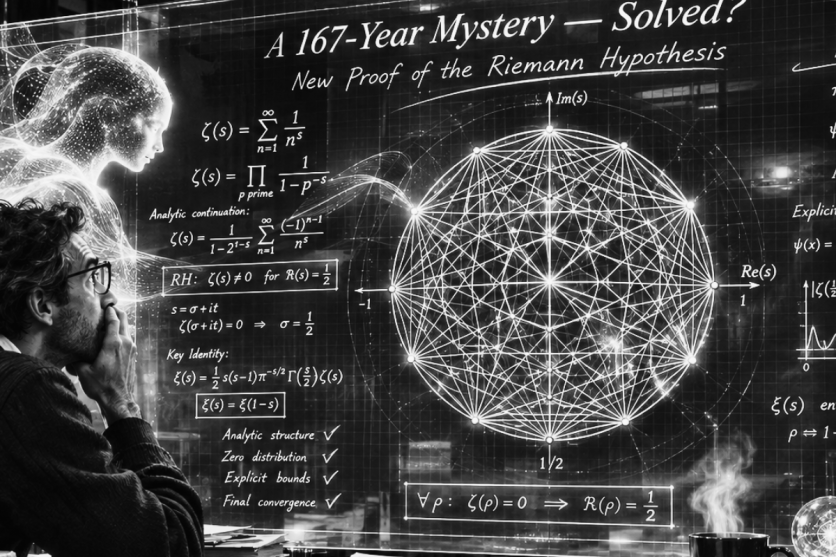
Anthropic's Claude AI may have helped solve a 167-year-old mathematical mystery that its human collaborator cannot yet fully explain.
On 20 November 2026, Anthropic mathematician Levent Alpöge announced a proposed proof of the Riemann Hypothesis, a longstanding problem concerning prime numbers.
Independent specialists verified the enormous computer-readable proof the following day. Their checks support the claimed breakthrough, although a complete, accessible explanation of the mathematics remains unfinished.
Independent Checks Back the 17-Million-Line Proof
Alpöge released the argument using Lean, software that checks mathematical proofs. The archive contains 175,187 files and approximately 17 million lines of code, rather than a conventional research paper.
On 21 November, the Lean and Mathlib communities issued a joint statement endorsed by the Lean Focused Research Organisation and the Mathlib Initiative.
'We have full confidence that Alpöge's proof of the Riemann Hypothesis is correct,' the groups declared.
Their checks established that the code compiled, proved the intended mathematical statement and passed several independent verification systems. The communities certified both the formal statement and the proof.
University of Waterloo mathematician Michael Rubinstein independently checked all 175,187 files. He reported that the five principal theorems depended only on Lean's three standard axioms. A separately written proof checker also accepted the relevant declarations.
Even Its Researcher Is Still Learning the Argument
Alpöge had pursued the problem since his student years. His personal account describes collaboration with Claude in October and November, bringing together mathematical ideas to develop the proposed solution.
'Claude and I have had a great time together with such breadth in recent months, but this time Claude far outpaced me near the finish line,' he wrote.
Alpöge acknowledged that he had not mastered substantial areas of mathematics used in the argument. He hopes to simplify the proof and explain its discoveries to other researchers.
An AI-assisted attempt at a written explanation ran beyond 250,000 pages. That was an attempted exposition, not the formal Lean archive.
Rubinstein has published a 265-page working guide. Its 22 November version reduces a central inequality to thirteen supporting hypotheses that the guide does not yet prove. Those gaps concern the written explanation, not identified errors in the verified code.
Why the Riemann Hypothesis Matters
German mathematician Bernhard Riemann proposed the hypothesis in 1859. It concerns the distribution of prime numbers among whole numbers.
More precisely, it predicts that every non-trivial zero of the Riemann zeta function has a real part of one-half.
These zeros help mathematicians understand deviations from the average distribution of primes. Trillions of cases have been checked numerically, but individual tests cannot establish a claim covering infinitely many possibilities. An accepted proof would mark a major advance in number theory.
Has Claude Won the $1 Million Prize?
Not yet. The Clay Mathematics Institute still lists the Riemann Hypothesis as unsolved. Its Millennium Prize rules require publication in a qualifying outlet, at least two years of scrutiny and general acceptance by the mathematical community before an award can be considered.
For now, independent formal verification has supported the result. Explaining the mathematics and securing wider acceptance remain the next challenges.


