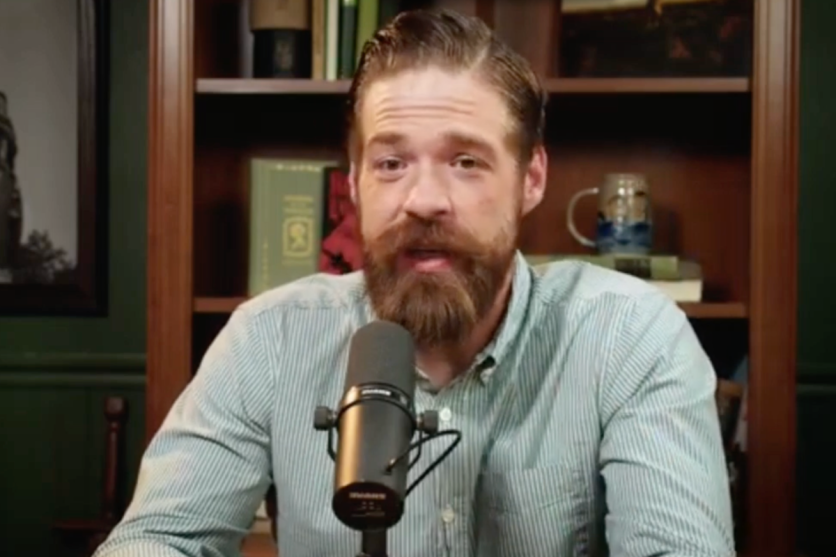
Brian Sauvé, a far-right Christian nationalist Utah pastor, says women should either stay off social media or have their accounts placed in a 'walled garden' managed by a 'competent man' who can curate, block and direct what they see.
Sauvé made the remarks during an 18 September episode of his podcast The King's Hall, which he co-hosts with Eric Conn. The episode, titled 'Lindsay Clancy, Mass Hysteria, & The Feminization of America', focused in part on what the two pastors described as the 'feminisation' of America.
'Women either shouldn't be on social media or any social media they have should be kind of a walled garden situation where some competent man is curating and blocking and directing and taking a look at what's going on,' Sauvé said.
'I have access to my wife's social media accounts and I have blocked — this is not an exaggeration — thousands of accounts,' he added, saying he had created a 'walled garden of cute goat videos' for his wife.
Sauvé also questioned the idea that women should have 'unsupervised access to one another', describing that as abnormal. He said women having political power and living unattached from a male, such as a father or husband, were among what he called modern feminist developments.
Sauvé's Comments Spark Online Backlash
The comments triggered a wave of criticism online after Right Wing Watch published clips from the podcast on 23 September. Some responses mocked Sauvé's argument, while others criticised what they saw as an attempt to place women's online activity under male control.
The latest controversy is not the first time Sauvé's comments about women and social media have generated backlash. In 2022, he faced a separate online storm after telling women there was no reason to post photographs of themselves in bikinis, bras or similar clothing. That episode prompted the #DearBrian hashtag, with users responding to his post by turning his own format back on him.
Sauvé later addressed the latest backlash, saying the podcast discussion was unscripted and explaining that his comments about women having 'unsupervised access to one another' did not mean women could not meet friends without their husbands present.
He said he did not believe a husband needed to 'lurk behind his wife whenever she's having lunch with a friend', but maintained that a husband should know who his wife is friends with and exercise oversight over the voices influencing her online.
Women's Digital Autonomy Meets a Growing Online Safety Debate
The latest controversy unfolded as governments, civil society organisations and private-sector representatives gathered on the sidelines of the 81st session of the United Nations General Assembly to discuss technology-facilitated violence against women and girls.
A G77 and Emerging Partners ministerial roundtable on technology-facilitated violence against women and girls was held on 23 September, with participants discussing online harassment, non-consensual intimate-image abuse, doxxing, cyberstalking and AI-enabled abuse.
UN Women Executive Director Sima Bahous called for barriers preventing women from participating safely online to be removed.
'We must remove the barriers that keep women from participating safely and from shaping the technologies of the future,' Bahous said.
A joint report from Refuge and the End Violence Against Women Coalition, based on nationally representative polling of 2,000 UK women aged 16 and over, found that 36% had experienced some form of online violence against women and girls. The figure rose to 47% among women aged 16 to 24.
The report also found that seven per cent of women surveyed said online violence had made them feel suicidal, rising to 15% among women aged 16 to 24.
The findings highlighted the extent to which online abuse can affect women's use of social platforms, with some respondents saying they had stopped using social media because of their experiences and others reporting inadequate responses when they sought help.
The US Conference of Catholic Bishops, meanwhile, has advocated for federal online-safety legislation aimed at protecting children. In a March 2026 letter to Congress, the bishops backed provisions of the Kids Online Safety Act and related legislation intended to address foreseeable harms to minors online.


