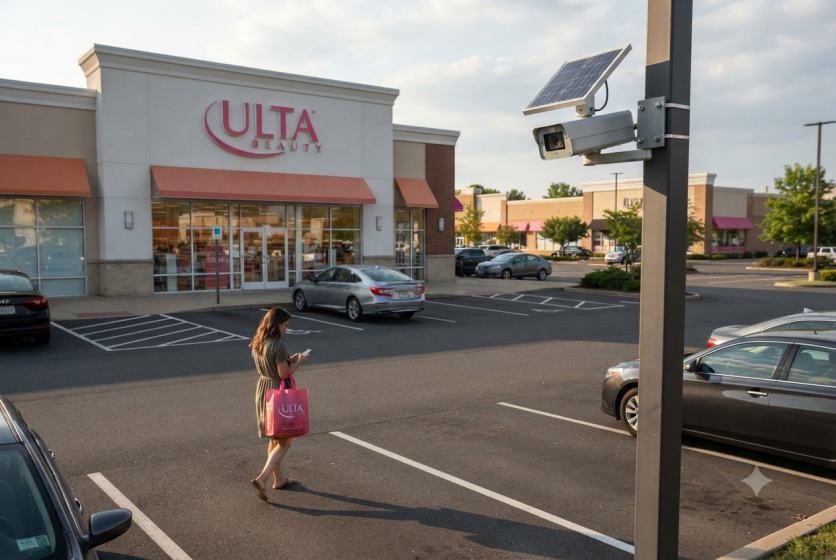
A routine trip to Ulta for mascara could leave behind an unexpected digital trail. Flock Safety cameras installed at some Ulta car parks can capture licence plates and where and when vehicles are detected, prompting women's rights advocates to warn about how that data could be accessed or misused.
The campaign, led by women's rights organisation UltraViolet, is urging Ulta to cut ties with Flock Safety, whose AI-powered cameras can record vehicle number plates and where and when they are detected.
The warning has been amplified by Instagram creator Rachel, who says documented cases of police officers allegedly abusing access to Flock technology to stalk and harass women show why the relationship deserves scrutiny.
For shoppers, the concern is unsettling: a routine trip to Ulta for mascara or shampoo could leave a searchable record of their vehicle's movements — raising questions over who can access that data, why they can search it and what happens when that access is abused.
'Did you know that Ulta has a massive contract with Flock Cameras?' Rachel asked.
Rachel claimed that Flock cameras are installed throughout Ulta's parking lots and warned that information captured by the system could potentially be misused by people with access to it.
'If you're a woman shopping at Ulta, the police can just watch you whenever they want,' she said.
Her video has since become part of a campaign by women's rights organisation UltraViolet, which is calling on Ulta Beauty to sever its relationship with Flock and remove the cameras from its parking lots. UltraViolet describes Ulta as one of Flock's biggest commercial customers. That characterisation comes from UltraViolet; the organisation does not publicly provide a figure for the size or value of Ulta's contract.
Recent reporting, however, indicates that Flock cameras are currently installed at less than 1 per cent of Ulta Beauty's store parking lots.
What Does Flock Actually Do?
Flock Safety's automated licence-plate recognition technology captures vehicle number plates and other characteristics, along with information about when and where vehicles are detected.
Flock says its cameras are designed to capture vehicle information such as licence plates, make, model, colour and other visible characteristics, rather than facial recognition or information such as a person's gender or race.
The company markets its technology as a crime-fighting and security tool, particularly for retailers dealing with organised retail crime. There is evidence that the system can help investigators connect crimes occurring at different locations.
Flock says its technology helped police identify three suspects linked to an organised retail crime ring that targeted multiple Ulta Beauty stores, resulting in more than $190,000 (£142,000) in losses.
In that case, Flock says Anne Arundel County police used its licence-plate reader cameras to locate a suspect vehicle connected to the thefts, helping investigators identify and apprehend three suspects.
But the same ability to identify where a vehicle has been can raise uncomfortable questions about privacy.
Rachel Warns of Potential Misuse
In an email to TechTimes UK, Rachel said her interest in Ulta's relationship with Flock came from her research into alleged police abuse of surveillance technology.
'I research police violence against women and track the growing number of officers abusing their access to Flock technology to harass, stalk, and abuse women,' she said.
'As women make the vast majority of Ulta's consumer base, I wanted to highlight their relationship with Flock after seeing blog posts made by the tech company on their commercial partnerships.'
Rachel pointed to several documented cases involving alleged misuse of Flock or other licence-plate surveillance systems.
One recent case involved Stow, Massachusetts, police officer Jason Rogers, who was accused of using Flock and other law-enforcement databases to obtain information about a former partner. A departmental investigation found that he had conducted multiple searches without a legitimate law-enforcement purpose. Rogers resigned on 26 August 2026, shortly before a scheduled termination hearing, and Stow subsequently ended its use of Flock.
The woman involved told Boston 25 News that the relationship had been abusive and that she had changed aspects of her life after leaving it. She later discovered that Rogers had used the Flock system to search for her location while working for the Stow Police Department.
Another case highlighted by Rachel involved Florida officer Lamar Roman, who was accused of using law-enforcement databases and an automated licence-plate reader system to track a woman he had met while working security on the set of the Apple TV+ series Bad Monkey. Roman had reportedly placed her licence plate on a surveillance 'hotlist', which could alert police when her vehicle passed an automated licence-plate camera.
Notably, the system involved in the Roman case was Guardian, made by Turing, rather than Flock Safety. The case is therefore relevant to the broader concerns around automated licence-plate surveillance, but it is not evidence of Flock technology being used in that particular incident.
Rachel said these cases demonstrate why she believes ordinary consumers should understand how the technology can potentially be used.
'It's important for everyone to understand that the police do not need a warrant in order to be able to track you using Flock cameras - you don't need to have been accused of or even suspected of a crime for a police officer to search for you thousands of times and even flag your license plate to prompt further surveillance,' she said.
'An officer could have seen you one time, think you're attractive, and then track your whereabouts for weeks after using Flock technology. There are woefully little restrictions put on how and/or when officers can use this technology,' she explained in the video.
Rachel's comments refer to her concerns about how officers may use access to Flock systems; the legal requirements for searches can vary depending on the jurisdiction, the circumstances and the type of information being sought.
The concerns are not limited to alleged stalking.
Recent reporting by StateScoop found that police agencies in New York had searched Flock's licence-plate database on behalf of Immigration and Customs Enforcement, including searches connected to immigration enforcement.
Flock, however, says it does not work with ICE and that federal access to Flock data is controlled by the agencies that own the data. The company says federal sharing is disabled by default and that it has introduced restrictions and filters concerning immigration and reproductive healthcare searches.
UltraViolet has similarly argued that Flock's technology poses risks involving immigration enforcement, reproductive healthcare and stalking. The organisation is urging Ulta to end its relationship with the company.
Why Does Ulta Use Flock?
There is, however, another side to the debate.
Flock's technology is not marketed as a tool for monitoring innocent shoppers. Its stated purpose is to help businesses and law-enforcement agencies identify vehicles associated with crime and investigate incidents.
For Ulta, the threat is particularly tangible.
The retailer has been targeted by organised theft groups, with Flock's own case studies describing investigations involving significant financial losses.
Flock says its technology has also been used in an Ulta Beauty burglary investigation in Missouri that ultimately linked one suspect vehicle to 15 additional Ulta burglaries across six states, with combined losses of approximately $300,000 (£225,000). The case resulted in an arrest and criminal charges.
The technology can therefore provide a valuable security benefit — but critics argue that those benefits must be weighed against the potential consequences of creating a searchable record of vehicle movements.
Rachel believes the balance currently favours protecting consumers.
'While I understand the intention of wanting to use Flock's technology to combat organised retail crime, the reality is that this kind of mass surveillance disproportionately impacts Ulta's consumers,' she told TechTimes UK.
She added: 'I personally have never read about a single case in court where Flock's technology has been successfully leveraged to take down an organised retail crime enterprise. I have read truly dozens of legal cases in just the last year where a police officer has been fired, arrested, or convicted for abusing Flock technology to stalk and harass women, and the number of cases just keeps going up.'
Flock disputes the broader characterisation of its technology as unrestricted mass surveillance, saying its systems include access controls, search logs and other accountability measures. In August 2026, the company announced further safeguards, including reducing default data retention to seven days and making misuse detection mandatory for customers.
For Rachel, the issue ultimately comes down to whether companies should be willing to accept the risks associated with such technology.
'Consumers of Ulta, the vast majority of whom are women, should not have to navigate whether or not they are being tracked by a predatory officer each time they go to Ulta,' she said.
The Bigger Question for Ulta Shoppers
The presence of a Flock camera does not mean police are automatically watching every person who enters an Ulta car park.
The more complicated issue is what happens after a vehicle's number plate has been captured.
Who can search that information? What constitutes a legitimate search? How long can the data be retained? And what happens if an authorised user abuses access to follow someone for personal reasons?
Flock says every search is logged and that customers control how their data is shared and accessed. The company has also introduced additional safeguards in response to concerns about misuse.
Rachel believes companies have a responsibility to consider those questions before entering into surveillance partnerships.
'When new technologies are found to be grossly enabling this misconduct, companies should prioritise their consumer bases by avoiding these kinds of surveillance contracts – at the very least, until real remedies have taken place,' she said.
For Ulta customers, that leaves a deceptively simple question hanging over the next trip to the beauty store:
When you drive into a car park to buy mascara, how much information about that visit should be recorded — and who should be allowed to see it?
UltraViolet wants Ulta Beauty to answer that question by dropping Flock with a catchy slogan: 'Mass Surveillance Isn't Pretty'.
Frequently Asked Questions
- What is Flock Safety?Flock Safety is a company that provides automated license-plate recognition technology to capture vehicle information for crime-fighting and security purposes.
- Why is there a campaign against Ulta Beauty's use of Flock Safety?The campaign is concerned that Flock Safety's surveillance technology could be misused to stalk women and infringe on privacy rights.
- What are the potential risks of using Flock Safety's technology?Potential risks include misuse by law enforcement to track individuals without a warrant, privacy concerns, and unauthorized access to personal data.
- How does Flock Safety justify its technology?Flock Safety markets its technology as a tool to help businesses and law enforcement identify vehicles associated with crime and investigate incidents.
- What measures has Flock Safety taken to prevent misuse?Flock Safety has implemented access controls, search logs, accountability measures, and reduced default data retention to seven days to prevent misuse.


