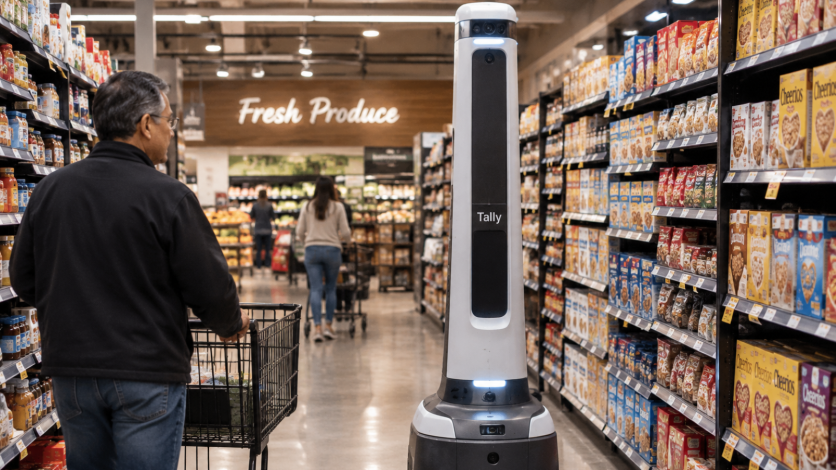
Ricardo Valadez was shopping at a Ralphs supermarket on Pico Boulevard in Los Angeles when a six-foot robot appeared to be following him through the aisles. The 62-year-old real estate agent, who regularly visits the store, initially wondered why the machine was moving so close to him.
An employee eventually explained that it was checking supermarket shelves rather than following customers.
The robot, called Tally, was developed by Simbe Robotics to help retailers monitor stock levels, identify misplaced products and spot pricing errors. Simbe says Tally is designed to understand shelf conditions and does not identify or track people.
However, its presence in supermarkets has raised questions about data collection, customer comfort and whether automation could eventually affect jobs traditionally performed by grocery workers.
How Tally Robots Check Supermarket Shelves
Tally sends information to store teams so employees can investigate and correct issues with product availability, placement, labels and prices.
Simbe introduced Tally 4.0 in January, featuring updated Nvidia computing hardware and software designed to speed up shelf scans and provide more timely information to retailers. The company says the technology can also help stores assess product positioning, promotions and pricing.
Simbe says more than 3,000 robots have been contracted worldwide, while a LinkedIn post from a manager at Kroger-owned Smith's Food and Drug stores reported that Kroger had deployed its 500th robot across the company in August.
The 3,000 figure refers to units under contract, rather than confirmation that every robot is already operating in a store.
Questions remain about what information these machines collect. Simbe's service terms define 'Tally Digital Data' as information that can include product photographs or videos, assessments of displays, product tags and pricing.
Those terms do not, by themselves, establish whether shoppers appear in captured material or how long any such footage might be retained. Simbe maintains that Tally is designed to assess merchandise and shelf conditions, not identify or track people.
Grocery Workers Fear Robots Could Affect Jobs
The Los Angeles Times reported that some Ralphs employees worry that technology introduced to scan shelves could eventually be used to monitor workers or change their responsibilities. These concerns do not establish that Tally is currently being used for employee surveillance.
In July, United Food and Commercial Workers Local 3000 opposed Tally's deployment at Kroger-owned Fred Meyer stores.
The union, which represents workers in Washington, north-east Oregon and northern Idaho, argued that employees already perform many of the tasks assigned to the robots. It warned that transferring those duties to machines could affect working hours and employee benefits.
Kathy Finn, president of UFCW Local 770, has also called for workers to be consulted before new technology arrives in their workplaces. Her position reflects concerns about how automation could affect employees who already check shelves, identify out-of-stock products and maintain store conditions.
Kroger's wider employment plans have added another dimension to the debate. The company announced it would eliminate 3,000 corporate positions over three years as it expands its use of artificial intelligence.
These planned cuts concern corporate roles and are not evidence that Tally has directly replaced supermarket employees. However, they provide context for questions about how Kroger intends to balance technology investment with its workforce.
Simbe says Tally can save employees up to 50 hours of work per week, although this is the company's own claim rather than an independently established result for every store.
For shoppers, the question is whether robots make it easier to find products without making supermarkets feel less welcoming.
For workers, the issue is whether automation supports existing teams or gradually shifts work away from them. The outcome will depend on how retailers introduce the technology, explain its purpose and involve employees in decisions about their workplaces.


