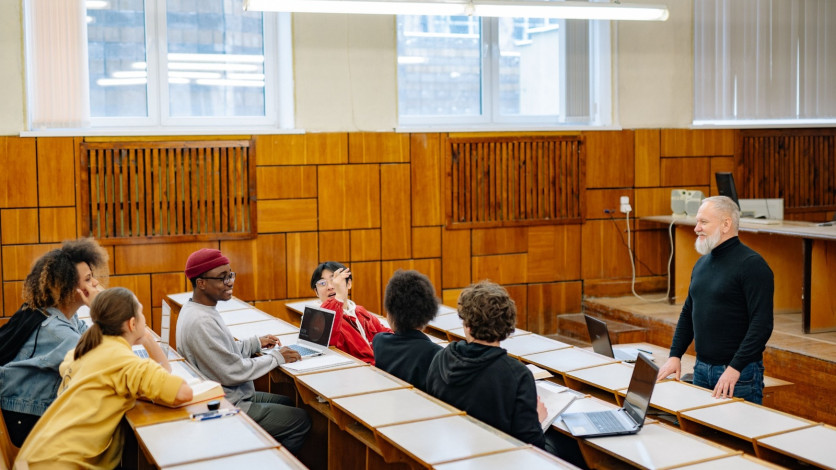
Artificial intelligence (AI) could reduce the role of human teachers in universities as institutions increasingly automate educational tasks, researchers have warned, raising concerns about the quality of learning, critical thinking and student interaction.
In a 2025 paper published in AI & Society, researchers Robert Sparrow and Gene Flenady argue that replacing university teachers with AI risks overlooking the social and intellectual aspects of education. Their analysis challenges expectations that generative AI can improve higher education without undermining the purpose of teaching.
Researchers Question Al-Led University Teaching
The paper, titled Bullshit Universities: The Future of Automated Education, examines the growing enthusiasm for generative AI in tertiary education.
The researchers argue that the technology's ability to produce essays, summarise research and answer questions does not necessarily mean it can replicate effective teaching.
AI tools can perform tasks traditionally associated with students and academic staff, including information retrieval, writing assistance and feedback generation. However, Sparrow and Flenady cautioned that automating these activities could encourage universities to replace human expertise rather than use technology to support it.
The researchers also question whether AI-generated responses provide the depth of understanding required in higher education.
They argue that students need to learn how to think critically and develop knowledge, rather than simply obtain answers from automated systems. The paper was published in the journal's 2025 volume, although its findings represent a scholarly argument rather than evidence that universities have already reduced teaching staff because of AI.
Human Interaction Remains Central to Learning
Sparrow and Flenady emphasise that education involves more than delivering information or completing academic tasks. Teachers also serve as role models and help students develop intellectual judgement through discussion, feedback and engagement with their subjects.
Morever, the researchers argue that these relationships are difficult to reproduce through automated systems.
AI can generate explanations and respond to questions, but its ability to produce convincing answers does not establish that it can provide the same educational experience as a human teacher.
The paper also warns that universities could face pressure to adopt AI-driven teaching models if automation is viewed primarily as a way to reduce costs.
Instead, the authors advocate investing in smaller classes and teachers with strong subject knowledge, while teaching students how to use AI appropriately as a supplementary tool.
2026 Data Shows AI Use Expanding
Recent research indicates that AI has become widespread in university study, although the figures do not establish that human teachers are being replaced.
The Higher Education Policy Institute's Student Generative AI Survey 2026, published on 12 March, found that 95% of surveyed UK undergraduates used AI in at least one way, while 94% used generative AI for assessed work.
The survey, based on responses from 1,054 full-time undergraduates, also found that only 48% felt their teaching staff were helping them develop AI skills for future careers. Meanwhile, 49% believed AI had improved their student experience, highlighting the mixed effects of the technology on learning.
Furthermore, a separate QS report published on 15 June 2026 found that 67% of academics and 62% of students used generative AI at least weekly for teaching, research, study or administrative work.
The findings illustrate how AI is becoming embedded in higher education, but they do not demonstrate a corresponding decline in human teaching positions.
Meanwhile, the Organisation for Economic Co-operation and Developement (OECD) 2026 report on AI in education emphasises the importance of retaining human oversight as univerisities adopt AI tools. 'GenAI should assist professional judgment, not replace it', the report states.


