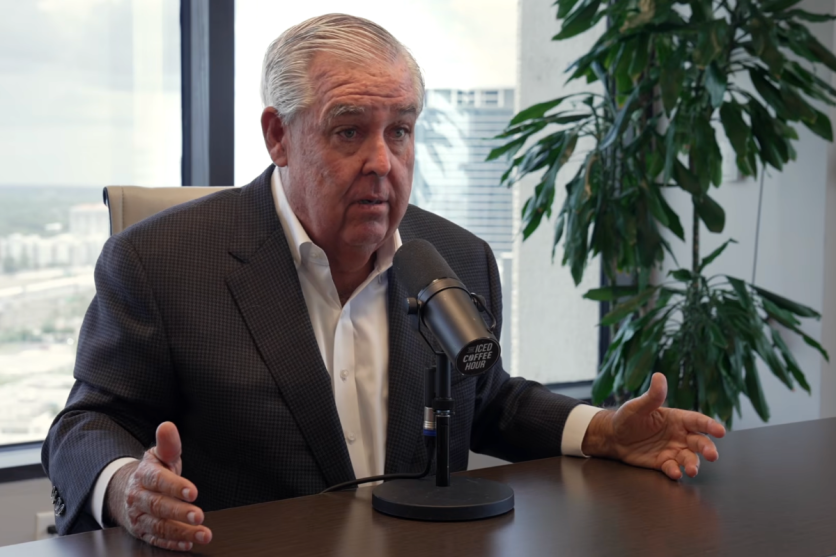
In an explosive interview, billionaire attorney John Morgan of Morgan and Morgan, one of the largest personal injury law firms in the US, threatened to put cameras on remote employees. Twenty-three workers quit in a single week.
Morgan, 70, appeared on the 27 August episode of The Iced Coffee Hour, where he discussed his path to building a billion-dollar legal practice. Toward the end of the episode, he turned to the subject of remote work and described a workplace confrontation that has since drawn national attention.
'We're going to put a camera on your computer. We're going to put a camera up your a**,' Morgan said, describing how he responded to employees who resisted returning to structured oversight after the pandemic loosened office norms.
Morgan did not mince words about what he believed was driving the resistance. 'It's not that they don't want to work from home. They don't want to f***ing work,' he said.
He added that after his firm introduced closer monitoring for remote staff, 23 employees quit within a week. The conditions that triggered the resignations, according to multiple reports, included a six-day workweek and nine-hour shifts alongside the prospect of expanded digital surveillance.
'Look, there are people that I have no problem working from home because there are certain people that, you know, they're going to work from home,' he said, adding, 'but very few.'
'So what I think is they don't want to work, and they're mad when they're caught,' he said. 'But deep down, if they're honest, they're mad at themselves.'
The $4 Billion Industry Behind the Threat
The global market for employee-monitoring technology is expected to exceed $4 billion in 2026. A separate market analysis valued the employee monitoring software segment alone at $2.5 billion, driven by the widespread adoption of remote and hybrid work arrangements and an increased employer focus on data security and insider threat mitigation.
Thousands of employers across the country are already using tracking technology to monitor employee whereabouts, productivity, and communications, according to the LA Times. Digital tools now track locations, task completion rates, and, in some configurations, access work-issued smartphone and laptop cameras.
Advances in artificial intelligence and data science have enabled employers to build what experts describe as extensive dossiers on individual workers, compiling behavioural patterns from keystroke loggers, screen capture software, and real-time productivity metrics.
Wilneida Negrón, director of research and policy at Coworker, a nonprofit worker advocacy organisation, said, 'Oftentimes, the workers with the least amount of power in the labor markets tend to be testing grounds for some of the more intrusive forms of data collection.'
When Surveillance Meets Attrition
The Morgan episode is an extreme public expression of a tension playing out quietly across thousands of American companies: employers deploying more monitoring tools, and workers walking away because of it.
But the Morgan and Morgan situation is not the only recent case to surface publicly. In one instance, a worker who quit after one week over a combination of a six-day workweek, long shifts, and close monitoring was subsequently denied pay for the time already worked.
A similar account involved an employee who left after seven days, citing a toxic environment with strict nine-hour daily shifts and no apparent flexibility.
Meta also faced internal backlash earlier in 2026 over an artificial intelligence-powered tracking tool that employees said monitored their home internet usage and extended beyond basic activity logging. Meta did not disable the tool entirely following the complaints but added an opt-out option, which would work only for half an hour at a time.


