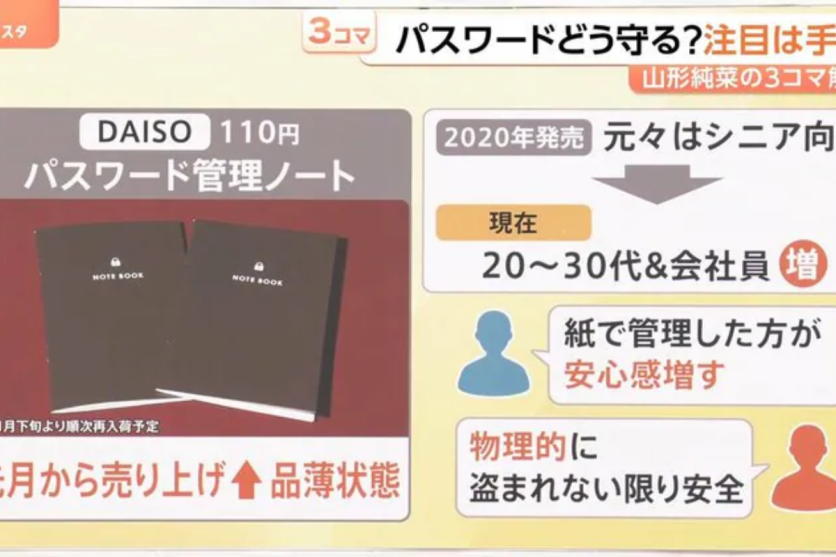
Japanese consumers are turning to paper to manage their online passwords, with notebooks selling out at major retailers as cybersecurity concerns grow.
Seoul Economic Daily reported on 24 November 2026 that demand is spreading beyond older shoppers, with younger buyers increasingly purchasing dedicated books to record their login credentials.
For context, managing passwords across dozens of websites has become a challenge for many internet users. Reusing identical login details offers convenience, but a series of cybersecurity incidents in Japan has highlighted the risks of relying on the same credentials across multiple platforms.
Why Are Password Notebooks Selling Out Across Japan?
The shift is becoming visible in Japanese retail sales. Household goods retailer Hands recorded a 50 per cent year-on-year increase in monthly password notebook sales, with demand extending beyond its traditional customer base.
One popular product is Hightide's password notebook, which costs 660 yen. The notebook had sold out on Hands' online shopping platform as of 17 November 2026.
A Hands representative said younger shoppers were increasingly purchasing the product, which had previously attracted predominantly older customers.
相次ぐ情報流出、紙にメモが最強?相次ぐ情報流出で「パスワード」どう守る 100均「専用ノート」品薄に…若者は“アナログ回帰” 企業は個人情報を手放す動きhttps://t.co/6u3hQUWFRI pic.twitter.com/e7XGfFyAdH
— suizouさんと他2025人の愉快な仲間 (@suizou) November 23, 2026
'Our customer base has widened beyond people in their 60s and older,' a Hands representative said.
Daiso has also seen demand rise for its 110-yen password notebook, introduced in 2020. Sales have increased since October, with buyers in their 20s and 30s increasingly purchasing the product to record website names, user IDs and passwords.
Daiso's official Japanese online store had also sold out of the product as of 24 November 2026. Neither retailer has disclosed the exact number of notebooks sold or how long the shortages might continue.
How Have Japan's Data Breaches Changed Password Habits?
The growing demand for password notebooks follows cyberattacks targeting Japanese businesses, universities and government agencies.
Japan's Personal Information Protection Commission recorded approximately 260 million instances of personal information being leaked or potentially exposed between 1 April and 16 October 2026, including duplicate records. Affected businesses included Muji operator Ryohin Keikaku, Nitori, Times Car, GMO Internet Group and Monex Securities.
Ryohin Keikaku said credit card numbers belonging to approximately 1.09 million Muji Card members may have been exposed. The figure concerns potentially exposed information, not confirmed fraudulent transactions.
The incidents also affected Osaka Metropolitan University and government agencies. Riken's Fugaku supercomputer was hacked, raising concerns about possible technology leaks.
Password reuse was identified as a contributing factor in some incidents, including Muji, although details remain unclear.
Nojima also recorded a 10 per cent rise in security software sales and a 5 per cent increase in router sales during October and November, respectively.
Are Paper Password Notebooks Actually Safer?
Writing passwords in a notebook is not necessarily unsafe. The UK's National Cyber Security Centre considers paper records acceptable in certain circumstances, provided they are stored securely.
Although they are less exposed to remote hacking, a lost or stolen notebook could reveal multiple account credentials.
Japan is not alone in confronting cybersecurity concerns. South Korea has also experienced major incidents involving SK Telecom, KT, Lotte Card and Coupang.
The Korea Internet and Security Agency recorded 2,383 reported cyber intrusion cases in 2025, a 26.3 per cent increase from 1,887 in 2024. Despite those incidents, dedicated password notebooks have not attracted the same level of attention in South Korea as they have in Japan.
As of 25 November 2026, Hands and Daiso were both experiencing shortages of their password notebooks, with younger consumers increasingly joining older shoppers in seeking an offline way to manage their digital credentials.


