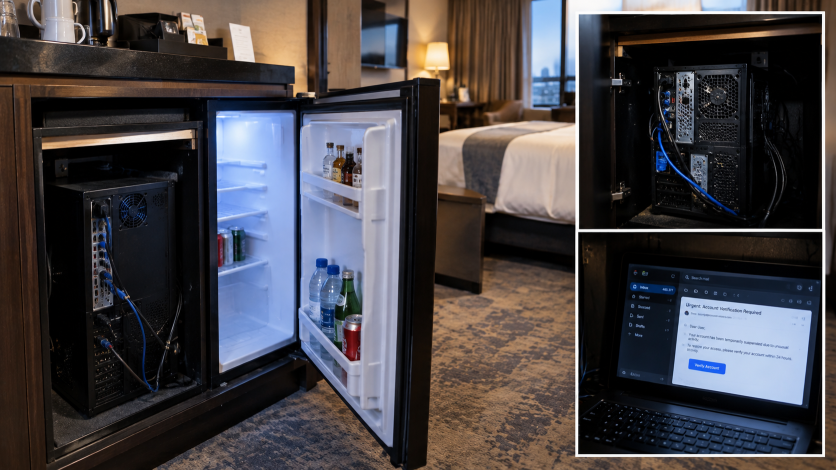
Guests came and went. Housekeeping changed the sheets. And behind the fridge, a hidden computer allegedly worked the night shift, pumping out around 480,000 phishing emails from a stash of 2.4 million addresses. This wasn't a hotel room anymore. It was a scam factory with room service.
The question was: who put it there? The computer was reportedly installed by a Chinese couple who lived locally, allowing the device to exploit the hotel's Wi-Fi while remaining out of sight.
The emails looked like they came from credit card companies, but the links led to fake sites built to steal financial details
Ye Jiafeng, 39, and his wife, Shen Qi, 39, have since been arrested over the alleged operation, as well as a separate series of purchases made using stolen credit card information.
It's a good reminder that one small computer can reach a lot of people, even one tucked behind a hotel fridge.
The Computer That Turned a Hotel Room Into a Phishing Factory
The alleged scheme began on 15 May 2025, when Ye reportedly plugged the computer into the hotel's Wi-Fi and then hid it behind a fridge.
Nobody had to sit in the room and run it. The machine was believed to be managed remotely, so it could keep sending emails without anyone coming back to check on it.
When investigators found it, it reportedly held around 2.4 million email addresses. That doesn't mean 2.4 million people were targeted, or scammed.
The computer had sent about 480,000 phishing emails. It's still unclear how many arrived, how many were opened, or whether any led to stolen financial information.
Still, it's quite a contrast: a device in an ordinary hotel room allegedly sent hundreds of thousands of messages, with millions of addresses potentially at risk.
One Email Exposed the Hidden Operation
The computer might have stayed hidden much longer if one recipient hadn't gotten suspicious. That person contacted the hotel after receiving a strange email.
After getting a suspicious email, they contacted the hotel. The hotel's IP address, a number that identifies an internet connection, appeared in the messages' metadata. That gave investigators a trail straight to the building.
Hotel staff found the computer and reported it to police. It makes you wonder how long the operation could have kept going if nobody had flagged that email.
Police are still investigating whether Ye and Shen masterminded the alleged scheme or were carrying out instructions on behalf of someone else.
74 Phones Seized, £47,620 in Alleged Stolen-Card Spending
The phishing operation was not the only alleged fraud linked to the couple.
Media reports say Ye and Shen used credit card details stored on a smartphone to purchase items in Kobe, Japan.
Police reportedly found 74 mobile phones at their home, although it is unclear whether these accounted for every device used in the alleged fraud.
Since 2024, the couple are alleged to have spent 10 million yen (£47,620) — using stolen credit card details.
That many phones raises questions about the scale and organisation of the alleged activity. Their presence alone, though, doesn't show how each one was used.
Investigators have reportedly brought multiple charges against the couple, including fraudulent obstruction of business, trespass and computer fraud.
The investigation has yet to establish whether they were responsible for the wider operation or were working as part of a larger criminal network.
The Growing Business Behind Phishing Scams
Phishing has become a persistent problem for internet users, with criminals impersonating trusted organisations to trick people into handing over sensitive information.
The business has also developed beyond individual scammers building fake websites themselves.
Earlier this year, the FBI dismantled a China-based phishing-as-a-service operation that allegedly helped criminals create scam websites using artificial intelligence.
The service is believed to have been linked to almost $2 billion ( £1.49 billion) in losses and 3.87 million stolen credit cards.
Services like these make online fraud easier. They hand criminals tools that would be hard to build on their own.
The hotel case in Japan shows a different piece of the same puzzle: a small device tucked out of sight can launch an operation that reaches far and wide.
Behind one hotel fridge, an ordinary room allegedly became anything but ordinary.


