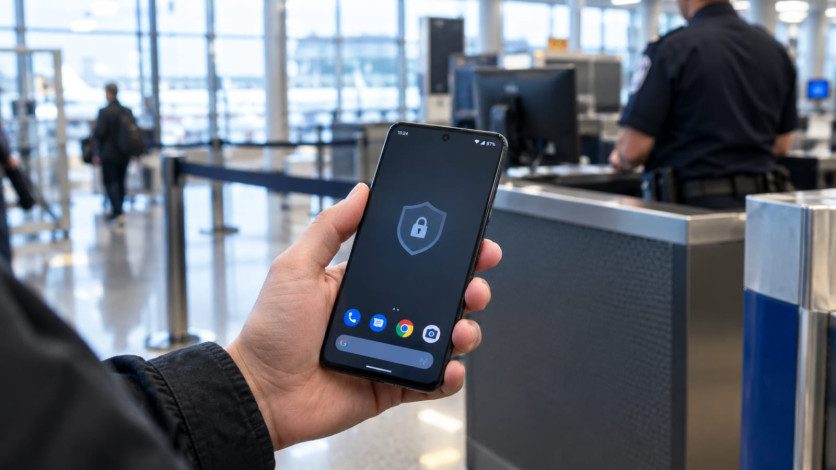
Newly filed court records have raised questions about why federal authorities targeted Samuel Tunick, an activist associated with Atlanta's Stop Cop City movement, during an airport inspection in January 2025.
An internal alert from Homeland Security Investigations (HSI) described Tunick as being under investigation for suspected 'terrorist activities', while Customs and Border Protection (CBP) officers reportedly told him they wanted to check his phone for 'kiddie porn'.
The records include a screenshot of the alert and photographs from the encounter, according to 404 Media, which published its report on 20 October 2026.
Tunick is facing a federal charge over the alleged deletion of data from his phone after officers sought access to it.
His lawyers are asking a court to exclude evidence from the encounter, arguing that officers used an unfounded accusation to justify their actions. The documents record different explanations for the inspection, with the internal alert referring to a terrorism investigation and officers reportedly raising the possibility of child sexual abuse material.
Homeland Security Alert Cited Suspected Terrorist Activities
An email from an HSI official to CBP and other officials instructed personnel to direct Tunick to secondary inspection when his flight arrived at Hartsfield-Jackson Atlanta International Airport. The message included his photograph and asked officers to retain his electronic devices and collect their passcodes.
The email stated: 'TUNICK is under investigation by HSI/JTTF for suspected terrorist activities.'
HSI is part of US Immigration and Customs Enforcement (ICE), while CBP is responsible for border inspections. The alert therefore records the stated reason communicated between agencies, rather than the explanation reportedly given directly to Tunick during questioning.
According to the court records described by 404 Media, CBP officers asked Tunick whether they would find 'kiddie porn' on his phone. He denied the suggestion. His lawyers argue that officers had no factual basis for raising the accusation.
In their filing, the lawyers wrote: 'As the evidentiary hearing made clear, these unfounded accusations were nothing more than pretext for a fishing expedition into the depths of Mr. Tunick's devices.'
They added: 'Officer Findley acknowledged that officers had no reason whatsoever to believe Mr. Tunick possessed child pornography.'
These statements represent the defence's arguments and account of the evidentiary hearing, rather than a judicial finding that officers deliberately misrepresented the purpose of the search.
GrapheneOS Phone Wipe Could Carry Five-Year Prison Sentence
The criminal case concerns Tunick's Google Pixel phone, which ran GrapheneOS, an operating system designed with a focus on security and privacy. According to the charge quoted by 404 Media, he allegedly deleted the device's digital contents to prevent the government from taking it into its custody and control.
Prosecutors have charged him under a federal law concerning the destruction or removal of property to prevent its seizure. He faces a maximum sentence of five years in federal prison if convicted.
Matthew Dodge, one of Tunick's lawyers, previously told 404 Media that he had found only one other case involving the same law, concerning drug trafficking. 'This is extraordinarily rare,' Dodge said. That statement reflects Dodge's research and is not an independently verified count of every prosecution under the statute.
Authorities investigated people associated with the Stop Cop City movement in connection with allegations including arson, vandalism and doxing. According to 404 Media, Tunick is not suspected of any crime beyond the alleged wiping of his phone.
The case raises questions about the extent of US authorities' powers to search electronic devices at the border. Officials have long relied on border-search powers to inspect travellers and their belongings, but the legality of a particular search depends on its circumstances.
Tunick's lawyers argue that the circumstances of his detention and the reasons given for questioning him make the evidence inadmissible.
The defence has filed a motion to suppress evidence. According to reporting published on 21 October, Tunick's reply brief was due on 23 October, with a ruling on the motion not expected before late October. The outcome could affect which evidence prosecutors can use as the case proceeds.
Tunick has argued that the prosecution could discourage people from protecting their personal information.
In an earlier statement to 404 Media, he said: 'I hope people understand that the charges against me are meant to intimidate people against protecting their data and their privacy, and the government hopes to set a precedent that no one has the right to privacy.'
That is Tunick's view of the government's motives. The court's decision on the suppression motion will address whether the challenged evidence can be used in the prosecution, rather than necessarily resolving the wider claims made by either side about the purpose of the investigation.


