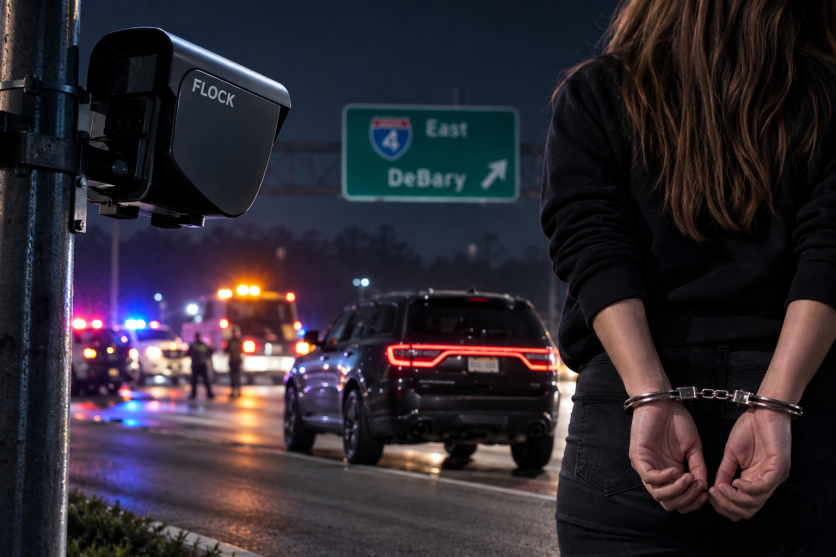
Lindsey Brooke Isaacs was jailed for 13 days over a deadly highway crash she says she did not cause. At the center of the case was a roadside camera that placed her Dodge Durango near the scene minutes before the collision.
The case against the 23-year-old Florida woman dates to the night of 4 October 2025, when a crash on eastbound Interstate 4 near DeBary, Florida, killed three people: motorcyclist Joaquin Deno, Flagler County Deputy Administrator Jorge Salinas, and his wife, Nancy Salinas. Witnesses told investigators a Dodge Durango was involved.
Flock Safety Camera at the Centre of Police Investigation
Investigators turned to a Flock Safety automated license plate reader, a roadside camera system used by law enforcement agencies across the country to capture vehicle images and identify license plates, to trace the vehicle. The camera recorded Isaacs' black Dodge Durango travelling eastbound near the Seminole and Volusia county line at 9:51 p.m. The crash happened at approximately 9:53 p.m. That camera sat roughly three miles west of the crash scene.
Isaacs' attorney, Patrick McGeehan, said his team performed a time-distance analysis and concluded that Isaacs was already beyond the crash location when the collision occurred. The Flock camera accurately recorded where her vehicle was, not where the crash was.
But investigators built their case around that sighting. Witnesses had described the suspect vehicle as a maroon Dodge Durango and provided a partial licence plate number. Investigators also found red or maroon paint transfer on a Ford Focus involved in the crash.
Isaacs drove a black Dodge Durango. A specialised Florida Highway Patrol (FHP) team that later inspected her vehicle reported finding no damage consistent with a collision with another vehicle.
Isaacs said she had been pointing that out from the start. 'Where is the damage on the vehicle?' she recalled asking police. 'Because I'm standing right in front of it and I don't see any damage.' Authorities impounded her SUV anyway. Months passed with no charges filed.
On 17 April 2026, Isaacs received a call from her attorney. She had to surrender that day. She faced eight felony charges, including three counts of vehicular homicide, three counts of leaving the scene of a crash involving death, leaving the scene involving serious bodily injury, and reckless driving causing serious bodily injury.
Isaacs said she spent her first several days in solitary confinement, with a toilet, a sink, and a metal sleeping slab covered by a thin mat. Her charges were serious enough that jail officials initially kept her separated from the general population.
'I was devastated, I was scared,' Isaacs said. 'I thought my life was over.'
Charges Dropped, Another Driver Arrested
The case shifted after prosecutors and a specialised FHP team took a second look. That team found no meaningful crash damage on Isaacs' Durango. Investigators revisited witness accounts and followed evidence pointing toward a different vehicle.
On 22 May 2026, the State Attorney's Office formally declined to prosecute Isaacs on all eight charges. Authorities then arrested Alisa Lee Montalvo on charges connected to the crash. Prosecutors allege Montalvo was driving a maroon Dodge Durango. She faces nine charges, including three counts of vehicular homicide and tampering with physical evidence. She has not been convicted, and the charges remain allegations.
Isaacs said she later received a personal apology from the head of the Florida Highway Patrol. 'I felt like a new woman,' she said. 'I felt free.'
'This took and is going to take maybe years to get better mentally, physically, emotionally,' she added. Isaacs has since filed a federal civil rights lawsuit against two FHP troopers involved in the investigation, alleging false arrest, wrongful imprisonment, and malicious prosecution.
Flock Safety disputed the characterisation of its role in the arrest. In a statement, the company said: 'Flock cameras provide investigative leads; they do not identify perpetrators, determine guilt, or make arrest decisions. In fact, the complaint itself calls the Flock evidence "exculpatory, not inculpatory," meaning the evidence pointed away from Ms. Isaacs rather than implicating her: it accurately placed her vehicle three miles from the crash scene just two minutes before the crash. Characterising her arrest as the result of Flock technology fundamentally misrepresents both the allegations and the role our technology played in this case.'
When asked whether Isaacs blamed Flock's cameras or the way investigators interpreted the data, she was direct. 'I 100% think the second one you said, how police interpret the camera footage,' she said.
Flock Safety CEO Garrett Langley has also publicly apologised over separate allegations involving misuse of the company's data by law enforcement. 'I apologise. It kills me that she went through that,' Langley said, according to CBS News.
Cities and Counties Across the US Are Cancelling Flock Contracts
The Isaacs case comes as a growing number of US cities and counties reconsider, cancel or suspend contracts with Flock Safety amid concerns over privacy, data access and law-enforcement use. The company says its network includes more than 120,000 cameras across 49 states.
The controversy has also reached state policy. Florida has moved to restrict license-plate readers on state highway rights-of-way, adding to the scrutiny surrounding Flock's expanding network.
In Oregon, the backlash has reached a scale that suggests organised resistance rather than isolated second-guessing. According to local reporting, six cities have cancelled their Flock contracts, and two counties have curtailed theirs, while Flock cameras remain in use at more than 500 locations across the state. The opposition has cut across partisan lines.
Ethan Krow, a critic of the network, warned that 'the result is an ever-growing volume of highly sensitive data about Oregonians' daily lives.'
In Bastrop, Texas, the city council ordered 12 Flock cameras covered following weeks of resident pressure over data collection and allegations of misuse. Six of those cameras had already been vandalised before the council acted.
The Los Angeles Police Department temporarily halted its relationship with Flock Safety over concerns about data ownership and sharing but later said it was negotiating a new agreement with additional safeguards, according to the Los Angeles Times. Flock Safety also faces a nationwide class action lawsuit over allegations that law enforcement officers used the company's camera network to stalk individuals.
Civil liberties organisations have been pushing for these cancellations for some time. The American Civil Liberties Union (ACLU) of Rhode Island called on the Cumberland Town Council to cancel its Flock Safety contract following the Isaacs case, noting that the cameras have been used to photograph drivers and passengers, not just license plates.
'This false arrest encapsulates the extremely serious privacy concerns that the ACLU and many others have been raising about Flock Safety and automated license plate reader cameras more broadly,' the organisation said in a public statement.


