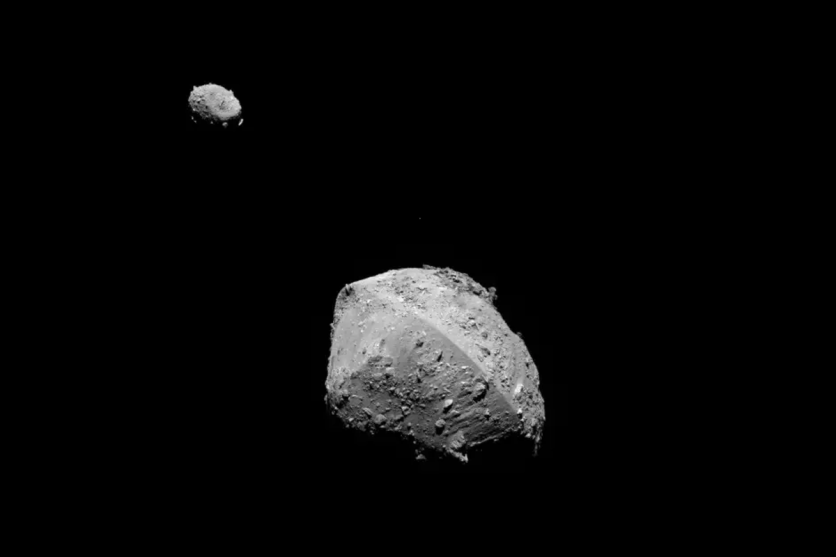
The European Space Agency (ESA) released images on 25 November 2026 showing a stadium-sized crater on Dimorphos, the asteroid moonlet NASA deliberately struck four years earlier.
ESA's Hera spacecraft also found the moonlet tumbling and spotted hundreds of boulders moving around it and its larger companion, Didymos. The Hera team will have to account for those rocks as the spacecraft moves closer.
What NASA's DART Test Measured From Earth
NASA's Double Asteroid Redirection Test (DART) sent a spacecraft into Dimorphos on 26 September 2022. Telescopes on Earth measured how much the collision shortened the time the moonlet takes to circle Didymos.
A 2024 NASA analysis put the eventual reduction at 33 minutes and 15 seconds. ESA says the change was larger than scientists had predicted. NASA says neither asteroid posed an impact threat to Earth before or after the test.
The result showed that a deliberate spacecraft collision could change the target's orbit. Hera is examining what the same collision did to the moonlet itself, giving researchers a way to relate the measured deflection to physical changes on the asteroid.
What Hera's Cameras Show on Dimorphos
Hera's main camera photographed both asteroids on 7 November 2026 from 29 kilometres away. Dimorphos measures 151 metres across, while Didymos is 730 metres across. The camera resolved about 2.7 metres of the scene per pixel.
Hera uses two identical cameras for its visible-light observations. The German Aerospace Center, which leads scientific work on the cameras, says they also help the spacecraft navigate. The same camera system therefore serves both the flight team and the researchers.
ESA paired a DART picture from shortly before the collision with a Hera image taken from a similar angle. The struck face of Dimorphos appears flattened, with the crater extending across it. ESA says boulder fields elsewhere on the moonlet look much as they did in DART's images.
Michael Küppers, Hera's mission scientist, said the follow-up images showed Dimorphos tumbling as it orbited Didymos. Hera used a separate instrument, its HyperScout H multispectral imager, to record hundreds of boulders moving around the pair in long exposures.
Hera also carries a thermal infrared imager supplied by the Japan Aerospace Exploration Agency. It measures surface temperatures, adding a second kind of observation to the visible-light pictures. The instrument recorded Dimorphos while the smaller asteroid was in Didymos's shadow.
Hera Plans a 13-Kilometre Approach in December
ESA plans to bring Hera to about 13 kilometres from the asteroid pair in December 2026. The agency expects the closer approach to yield more detailed images of the surfaces.
In January 2027, ESA plans to deploy two shoebox-sized satellites that will venture closer still. Juventas will use radar to probe an asteroid's interior and eventually attempt a landing. Milani will study the asteroids' surface material and the dust around them.
Earlier images gave the team another way to examine the system. British astrophysicist and Hera science team member Sir Brian May worked with Claudia Manzoni to combine frames taken moments apart into a three-dimensional view of Didymos. The paired images show the larger asteroid's equatorial ridge and surrounding boulder fields.


