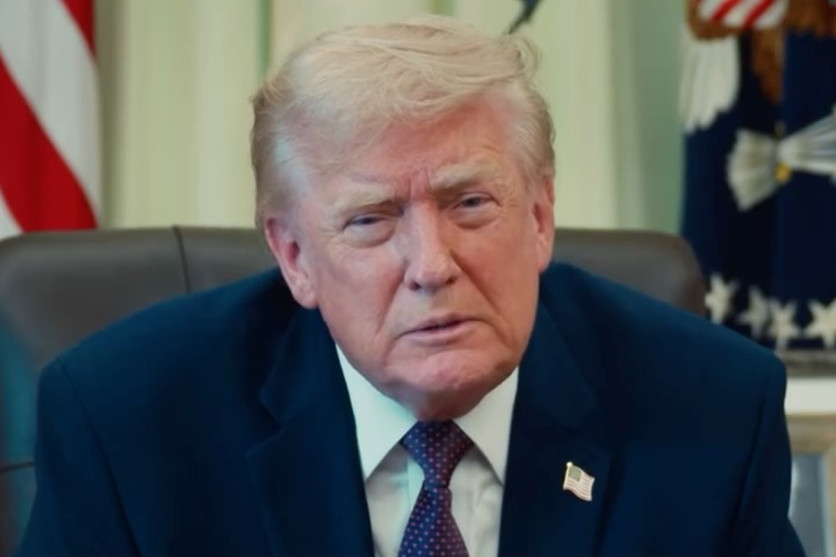
Donald Trump has proposed replacing the term 'Artificial Intelligence' with 'Super Intelligence' — but there is a catch: 'superintelligence' already has a specific meaning in the field of AI.
In AI discussions, 'superintelligence' generally refers to a hypothetical form of machine intelligence capable of surpassing human abilities across a broad range of tasks. It is therefore more than simply an alternative name for today's artificial intelligence technology. Axios notes that it is unclear whether Trump intended to invoke this existing technical concept when proposing the new terminology.
During his address to the United Nations General Assembly on Tuesday, 22 September, Trump said US government documents would henceforth use the term 'super intelligence' instead of 'artificial intelligence', while also expressing hope that other countries would follow suit.
Trump said: 'From this point forward, all of United States documents and hopefully the world's will be changed to use the much more accurate term "super" as opposed to artificial. So it's super intelligence.'
The announcement does not by itself establish that the term has been legally adopted as the formal name for AI across the United States. Rather, Trump's statement concerns the terminology used in US government documents. Reuters reported that Trump announced the terminology change during his UN address while also defending the continued development of AI.
Trump's Original AI Rebranding Proposal
The move follows social-media polls in which Trump asked users to choose a new name for the technology.
Writing on Truth Social on Saturday, 19 September, he argued that the standard terminology misses the mark, stating: 'Many people think that the words 'Artificial Intelligence' are inaccurate, and very ineloquent, relative to AI, or Artificial Intelligence.'
'A far more elegant and accurate description of this new phenomena would be Superior Intelligence (SI) or, Extreme Intelligence (EI) or, Supreme Intelligence (SI).'
Social Media Polls And Public Preferences
Trump used Truth Social and X to ask his followers to vote on three alternative names: 'Superior Intelligence', 'Extreme Intelligence' and 'Supreme Intelligence'.
Many people think that the words “Artificial Intelligence” are inaccurate, and very ineloquent, relative to AI, or Artificial Intelligence. A far more elegant and accurate description of this new phenomena would be Superior Intelligence (SI) or, Extreme Intelligence (EI) or,…
— Donald J. Trump (@realDonaldTrump) September 19, 2026
Across both platforms, the initial polls saw 'Superior Intelligence' capture the top spot. Drawing from a pool of more than 64,000 votes on Truth Social, it secured 41 per cent of the tally, beating out 'Extreme Intelligence' at 38 per cent and 'Supreme Intelligence' at 21 per cent.
Meanwhile, X users cast more than 226,000 votes, pushing 'Superior Intelligence' ahead with 41.5 per cent, followed by 'Supreme Intelligence' at 30.7 per cent and 'Extreme Intelligence' at 27.8 per cent.
VOTE!
— Donald J. Trump (@realDonaldTrump) September 19, 2026
Trump subsequently removed 'Supreme Intelligence' from the voting options, explaining that it was 'probably because of its relationship to the Supreme Court', and initiated a new vote featuring just the two remaining contenders.
“Supreme Intelligence,” probably because of its relationship to the Supreme Court, is losing badly to both “Superior” and “Extreme Intelligence.” Therefore, we are going to take “Supreme Intelligence” OUT, deleting it as a qualifier, and let you vote for the Final Two: Superior…
— Donald J. Trump (@realDonaldTrump) September 20, 2026
The second poll showed 'Superior Intelligence' ahead on both platforms, although voting was still active.
VOTE!
— Donald J. Trump (@realDonaldTrump) September 20, 2026
A Different Meaning For 'Super Intelligence'
Trump's final choice is notable because 'superintelligence' is already used within AI research and discussion to describe a level of machine intelligence that goes beyond human capabilities.
That established meaning is distinct from Trump's earlier poll options, which included 'Superior Intelligence' and 'Extreme Intelligence'. Trump ultimately used 'super intelligence' in his UN announcement rather than any of the three names offered in his original poll.
Trump is not the sole senior US official to have used an unconventional substitute phrase for the technology. During an April 2025 appearance at the ASU+GSV Summit, his secretary of education, Linda McMahon, repeatedly used the term 'A1' — the exact name of the well-known steak sauce brand — when discussing artificial intelligence in education.
AI Safety Fears And Global Tech Race
Trump made these remarks amid growing concerns about AI safety, following warnings from former Anthropic researcher Jacob Coxon. Coxon said that people building AI 'earnestly believe that it could kill us all by the end of the decade'.
Trump has opposed new AI regulations, while saying US law enforcement agencies would monitor the sector and intervene if necessary. During his UN address, he said the Department of Justice would 'watch it closely', according to Reuters.
The debate comes as the US and China compete over AI development and technology leadership. Artificial intelligence is also expected to feature prominently during Chinese President Xi Jinping's state visit to Washington, which is scheduled to begin on Wednesday, 23 September.
The Trump-Xi discussions are expected to include AI safety and governance, adding another layer to the broader debate over the technology's development and regulation.
Trump's proposal adds a new dimension to the broader debate over AI safety, regulation and US-China technological competition. Whether 'super intelligence' gains wider use beyond US government documents remains to be seen.


