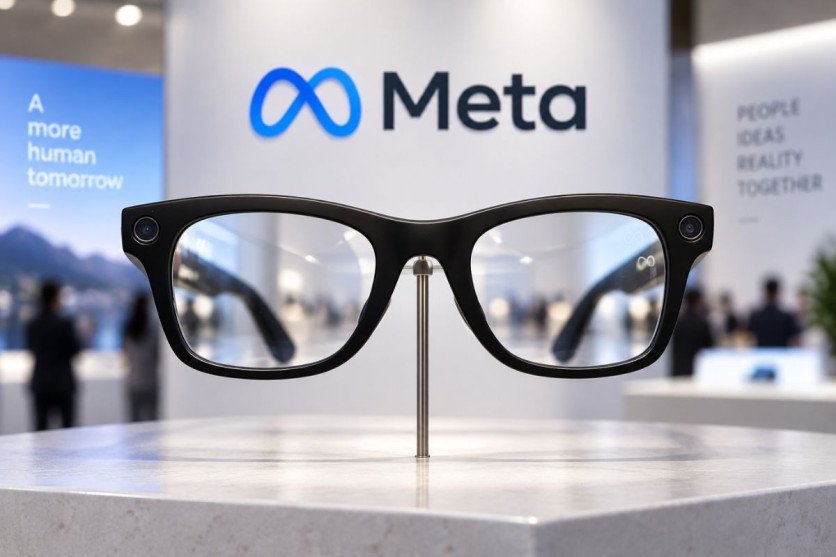
Meta is facing a proposed class action filed in federal court in Chicago on 4 September over NameTag, an unreleased facial-recognition system developed for its smart glasses.
Parents and children in Illinois and California allege Meta used Facebook and Instagram photos to create or process biometric information for NameTag and generative AI systems without the notice or consent required by law. They seek damages and an injunction.
Meta says the lawsuit is 'without merit'.
The case, Alvarez et al. v. Meta Platforms, Inc., asks whether Meta could have violated biometric privacy laws while developing the technology before any consumer rollout. No court has ruled that Meta broke the law, and the proposed classes have not been certified.
NameTag Code Reached an App With More Than 50 Million Downloads
NameTag first surfaced publicly in February, when reporting revealed that Meta was considering facial recognition for its smart glasses. In June, WIRED found dormant NameTag code inside Meta AI, the companion app used with Ray-Ban and Oakley smart glasses.
The app had been downloaded more than 50 million times. That figure refers to app downloads, not people using NameTag. The feature was never enabled for ordinary users.
WIRED found that NameTag was designed to convert a face captured by the glasses into a biometric signature, or faceprint, and compare it with faceprints stored on the wearer's phone.
Three AI models used by the system had already been deployed from Meta's servers to phones. One detected faces, another cropped them and a third encoded them as biometric data.
WIRED could not establish where the identification faceprints originally came from. That uncertainty now sits at the centre of the lawsuit.
Lawsuit Targets Facebook and Instagram Photos
The plaintiffs are Illinois resident Francisco Alvarez and his minor son, along with California resident Jeremy Wahl and his 10-year-old daughter.
Their complaint proposes national, Illinois and California classes covering people whose images were uploaded to Facebook or Instagram or submitted to Meta's generative AI systems. The class period begins on 4 September 2021, and the complaint says the nationwide group could number in the millions.
The lawsuit alleges violations of the Illinois Biometric Information Privacy Act, or BIPA, as well as California privacy and publicity laws.
The plaintiffs claim some NameTag faceprints may have been derived from Facebook and Instagram images. That has not been proved. The complaint acknowledges that Meta has not disclosed which images, if any, were used to generate the biometric information at issue.
It also challenges Meta's work on generative AI systems including Emu and Muse Image, alleging that photographs were used in ways that unlawfully created or used biometric information.
Meta Says NameTag Never Shipped to Consumers
'This lawsuit is without merit and misrepresents our work,' a Meta spokesperson told WIRED. The company said it has been transparent about how people's information is used to develop and improve its AI products.
Meta said NameTag never shipped as an available consumer feature and no final decision has been made about releasing it. Meta also said it is not building a universal face database.
Meta removed the NameTag code from the Meta AI app on 5 June, one day after WIRED published its investigation. It has not publicly confirmed whether the technology will return.
Meta Has Faced Costly Biometric Privacy Cases Before
Facebook agreed in 2020 to a $650 million settlement in an Illinois class action over facial-recognition technology. A court gave final approval in February 2021. Meta announced in November 2021 that Facebook's face-recognition system would be shut down and more than one billion facial-recognition templates deleted.
In 2024, Meta agreed to pay Texas $1.4 billion to resolve allegations that it unlawfully captured and used residents' biometric information.
Texas Attorney General Ken Paxton opened another investigation on 20 May 2026 into Meta's smart glasses, citing concerns about recordings, facial geometry, privacy representations and reported plans to add facial recognition.
The new case centres on what happened before any NameTag rollout.
The plaintiffs want the court to decide whether Meta collected or used protected biometric information without proper notice or consent, and whether those alleged practices should be stopped.


