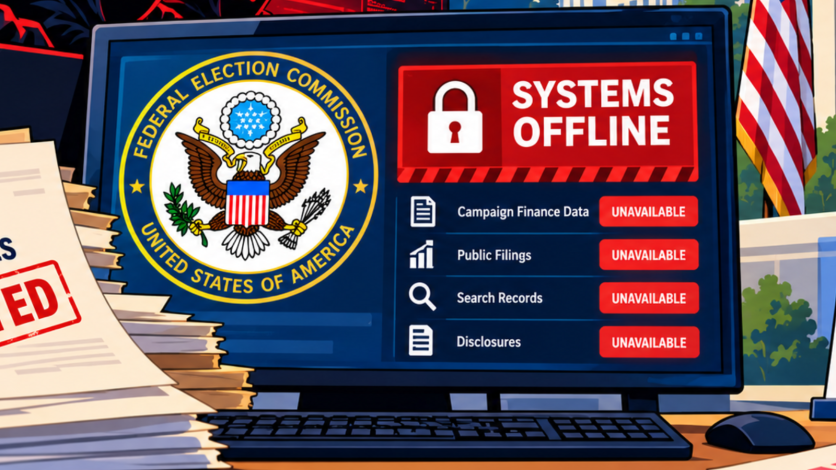
Hackers targeted the US Federal Election Commission (FEC), prompting officials to shut down public-facing services and disrupting campaign finance disclosures just days before the 3 November midterm elections.
The outage began on Monday night, 26 October, preventing political groups from electronically filing mandatory reports as billions of dollars flow into congressional races. The disruption has raised concerns about how much voters can learn about political spending before casting their ballots.
Political advertising spending and future bookings for the 2026 midterms have reached approximately $11.21 billion (£8.43 billion), according to advertising tracker AdImpact, as reported by Reuters.
That narrowly exceeds the $11.2 billion (roughly £8.4 billion) spent on political advertising during the entire 2024 election cycle, including the presidential race. However, the 2026 figure includes advertising booked for future use, not just completed spending.
The outage is delaying electronic disclosures intended to show who is financing political campaigns.
Hackers Target Election Watchdog as Filing System Goes Offline
The FEC's electronic filing system went offline at approximately 10pm Eastern Time on Monday following an attempted intrusion. An internal email obtained by Reuters revealed that an FEC electronic filings officer had warned campaign compliance firms about the threat.
'We have a bad actor attempting to breach FEC systems,' the official wrote.
The email explained that the agency had temporarily shut down its public-facing services in response.
The FEC subsequently confirmed that its electronic filing system was unavailable. Technical staff began working to restore access, while previously submitted campaign finance reports remained searchable on its website.
At 8:17pm Eastern Time on Tuesday, 27 October, the agency said it had identified the problem and was implementing a fix. However, its official incident page had not recorded a resolution as of Wednesday, 28 October.
The suspected attacker or attackers have not been publicly identified. Officials have not confirmed whether the attempted intrusion succeeded or whether sensitive information was accessed.
Millions Flow Into Campaigns as Spending Reports Stall
The outage comes during a critical period for political spending, with outside organisations pouring millions into competitive congressional races.
Brendan Glavin, research director at non-partisan campaign finance watchdog OpenSecrets, told Reuters that super PACs and dark money groups had spent an average of more than $50 million (around £37.6 million) daily over the preceding week.
More than $250 million (approximately £188 million) in spending was reported on 20 October alone.
These figures show why even a short disruption matters. Political organisations can spend heavily during the final days of campaigning, leaving voters little time to examine who is financing advertisements.
Super PACs can accept unlimited contributions from individuals, corporations and other permitted sources. They can spend those funds independently to support or oppose candidates.
Other politically active organisations, commonly called dark money groups, may finance election-related activities without publicly identifying all their donors. Campaign finance reports do not reveal every funding source. However, they provide important details about reportable contributions and expenditures.
Glavin described the outage as 'a big deal', stressing the importance of timely disclosures during the closing days of campaigning.
Why the $1,000 Disclosure Rule Matters Before Election Day
Federal campaign finance rules require faster disclosure as election day approaches.
Under FEC requirements, political committees and others making qualifying independent expenditures totalling $1,000 (£752) or more in the same race between 15 October and 1 November must file reports within 24 hours.
Candidate committees must also report qualifying contributions of $1,000 (£752) or more received between 15 and 31 October within 48 hours. These requirements give voters quicker access to information about significant last-minute contributions and independent spending.
However, the outage has prevented affected campaign compliance teams from submitting reports through the usual electronic filing system.
Steven Mele, president and chief executive of political finance compliance firm MBA Consulting Group, told Reuters that he had never encountered such a disruption in his 26 years in the industry.
The problem does not prevent political organisations from spending money. Instead, it creates a gap between campaign activity and the public disclosures used to track it.
Will the Attempted Intrusion Affect the Midterm Elections?
There is no publicly confirmed evidence that the attempted intrusion has affected voting machines, ballot counting or election results. The FEC oversees federal campaign finance regulation and disclosure. It does not administer elections or operate voting infrastructure.
Americans are scheduled to vote on 3 November, when Republicans will seek to retain their majorities in the House of Representatives and Senate. The immediate concern is financial transparency rather than the voting process itself.
Officials have not publicly established the full scope of the attempted intrusion or identified those responsible.
Questions also remain about when normal filing services will resume and how quickly delayed reports will become publicly available. Even if access is restored before election day, voters may have less time to scrutinise the organisations financing the final stretch of campaigning.
Political spending has not stopped. What remains uncertain is how much newly reportable spending voters will be able to examine before heading to the polls.


