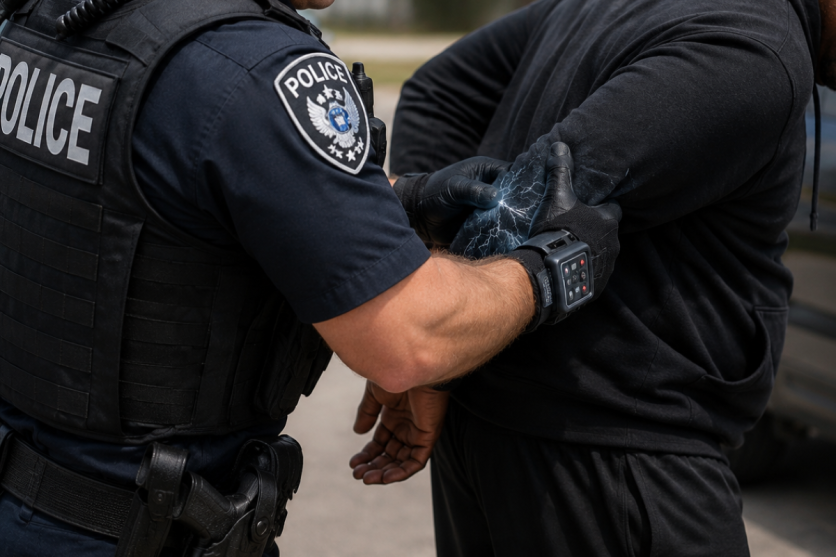
When police officers in Nebraska admitted to using electric-shock gloves on two students during the 2025-2026 school year, the devices drew widespread outrage.
The incidents followed reporting by the Guardian and 404 Media that revealed US Immigration and Customs Enforcement planned to spend upwards of £15 million for thousands of the gloves, putting the technology under national scrutiny.
Known as Generated Low Output Voltage Emitters, or GLOVEs, the devices deliver an electric shock intended to impair movement. Despite their recent attention, they have already been used by local police for years.
In Sahuarita, Arizona, Police Chief John Noland said officers had been using the gloves for around two years. He defended their use in an interview with the Daily Wire, rejecting concerns that such devices are inherently cruel or degrading.
Police Chief Defends GLOVE Use
Sahuarita, a town of just over 37,000 people, has a police force of around 68 officers. Noland said his department was the first law enforcement agency in Arizona to use the gloves during street and patrol work.
'We've been successful with them,' Noland said as per reports.
A United Nations special rapporteur on torture has described devices of this type as 'inherently cruel, inhuman or degrading'. Noland rejected that assessment.
'It is not inhumane,' he said. The chief also argued that the technology could make it easier for officers to deal with people who refuse to comply.
'Over the last few years of our federal agents, Border Patrol, ICE agents, and others, DHS, all struggling with people out in the field, trying to get them to comply, now becomes less of a struggle,' Noland said.
Legal rights analysts have raised concerns that this approach risks treating people as criminals who simply need to 'comply', while concerns have also been raised about potential misuse by police.
Students Were Among Those Shocked
The concerns have extended to schools. In Omaha, Nebraska, at least two students were subdued by school resource officers using GLOVEs during the 2025-2026 school year, according to NPR.
The first was identified as a student from another school who was found trespassing. When he attempted to flee, police applied a shock to his wrist for approximately two seconds before detaining him.
The second student attended Omaha Public Schools' Integrated Learning Program, which is described as a specialised programme for students with social, emotional, behavioural and learning deficits.
After the student made verbal threats and threw a chair at a school security guard, officers used two consecutive shocks, consisting of a one-second shock followed by a longer two-to-three-second shock.
Omaha police said they were 'constantly seeking ways to keep the public and police officers safe through innovations like GLOVE'.
There is also a case involving a Kentucky man who died in 2025 after jail employees allegedly shocked him with a GLOVE 27 times and used a taser on him 13 times, according to the pending lawsuit. The complaint says he subsequently suffered cardiac arrest.
The use of police technology in schools has raised wider concerns. The ACLU of Iowa found that school police are increasingly being used to handle minor disciplinary issues such as vaping and disrespectful conduct, rather than primarily deterring criminal activity.
The organisation also found that Black and disabled students are disproportionately cited and arrested by school police.
Another case highlighted the risks of security technology. In Baltimore last year, a Black high school student was handcuffed and detained by armed police after an AI-integrated gun detection system flagged his bag of Doritos as a possible weapon.
The incidents show how GLOVEs have moved beyond their use against violent adult suspects and into encounters involving school students. The Omaha cases, the Kentucky death and the planned federal purchase have placed more attention on how these devices are being used and who is subjected to them.


