California has introduced sweeping new workplace rules targeting several uses of artificial intelligence and workplace surveillance, including AI systems used in employment decisions, technologies that monitor workers in office restrooms and tools capable of collecting neural data.
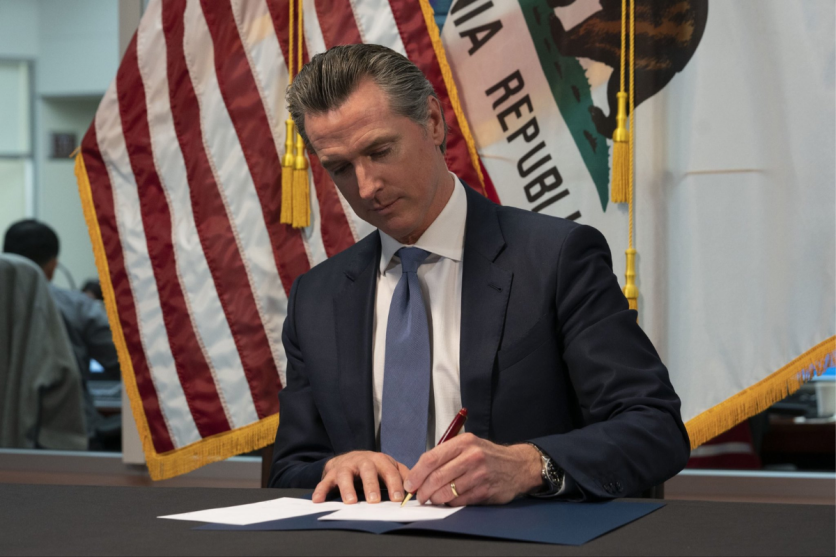
Governor Gavin Newsom signed several bills on Thursday that prevent employers from relying solely on AI for disciplinary or termination decisions, restrict certain forms of AI-powered workplace surveillance, and require employers to provide notice when AI causes a mass lay-off, relocation or termination.
The new rules also restrict employers from using AI-powered surveillance tools to collect neural data or recognise employees' emotional states.
The measures come amid growing employee anxiety over job losses, algorithmic bias and increasingly intensive workplace surveillance. Labour groups, employee advocates and some politicians pushed for the new standards, making California one of the first states to establish a broad set of workplace protections specifically targeting AI and automated technology.
'It's a turning point,' said Lorena Gonzalez, president of the California Federation of Labor Unions, AFL-CIO, who has been helping leaders across the country write regulations. 'It's really the first time we're seeing California workers showing the country that we don't have to accept [this].'
Colorado, Connecticut, Illinois and Texas have already enacted separate statutes addressing artificial intelligence on the job, although their measures are more limited than California's. Gonzalez said more bills are being lined up for consideration across the country.
AI Bathroom Surveillance Faces New Limits
The new rules target workplace monitoring practices such as heat maps that track staff movements, including systems capable of tracking how long workers spend in restrooms, as well as tools designed to assess employees' feelings.
Amazon warehouse workers have previously complained about being timed on their bathroom breaks, while Kaiser Permanente nurses have said automated systems rated how their voices sounded during patient interactions.
These examples illustrate the kinds of workplace monitoring that have fuelled concerns among workers and unions, although they are not themselves described as violations of California's new laws.
The new restrictions are intended to establish limits on workplace surveillance as companies adopt increasingly sophisticated AI systems.
'We don't know all the places companies are using AI, and that is and should be scary,' Gonzalez said.
Labour organisations and advocacy groups such as the California Federation have also been tracking new products released by technology companies as part of their efforts to identify workplace AI applications. Gonzalez said the availability of such software can provide an indication that it could also be used in workplaces.
The federation plans to use the momentum from the new laws to revive proposals including a requirement for employers to disclose when they are using AI in the workplace. That legislation died in the state's Assembly appropriations committee earlier this year.
Neural Data Faces New Restrictions
The legislation also addresses technologies capable of collecting neural data from workers, with the new workplace rules restricting employers' use of AI-powered surveillance tools to collect such information or recognise employees' emotional states.
Neural data refers to information derived from electrical signals from the brain or nervous system. The measures add workplace-specific restrictions to California's wider efforts to regulate sensitive data linked to neural activity.
Robin Feldman, who directs and founded the AI Law & Innovation Institute at the University of California College of the Law, San Francisco, said the new statutes mark an important milestone for labour advocates seeking to establish rules around workplace AI.
However, she warned that the legislation's enforcement mechanisms remain constrained.
'The bills have no private enforcement,' Feldman said. 'In other words: workers can't sue. Only the government can enforce the laws.'
AI Firings Also Face New Limits
One of the most significant measures is California's SB 947, the No Robo Bosses Act of 2026, which prevents employers from relying solely on automated decision-making systems to fire or discipline workers. Employers using such systems must have human oversight and verification.
The law also requires employers to inform workers when an automated decision-making system has been used in a termination or disciplinary decision. California's Senate describes it as the first law of its kind in the nation.
NEW: Building on his nation-leading executive order to prepare workers and businesses for potential AI disruption, @CAGovernor Gavin Newsom signed first-in-the-nation legislation that will protect people in the workplace from the impacts of artificial intelligence, automated…
— Governor Newsom Press Office (@GovPressOffice) October 1, 2026
The legislation comes as automated decision-making systems are increasingly being used by employers around the world to manage workplaces, including disciplinary and termination decisions, according to the bill's sponsor.
The changes follow growing employee resistance to workplace monitoring. Meta paused a programme that tracked workers' computer activities in June amid employee pushback, and a month later, dozens of employees filed a lawsuit alleging that the company's AI tools unfairly targeted workers with disability accommodations or those on medical or parental leave for lay-offs. The allegations have not been established in court.
'Workers are increasingly part of that movement, speaking up about the fear of job loss and the dehumanising experience of being surveilled and controlled by an algorithm,' said Annette Bernhardt, senior tech policy adviser at UC Berkeley Labor Center.
But the legislation has also drawn concerns about whether narrowly targeted restrictions could unintentionally affect useful workplace technologies.
San Francisco employment attorney Danielle Ochs said the new rules 'have teeth', although their wider impact remains uncertain. She said employers generally are not grappling with all of the specific AI uses covered by the legislation and are instead more focused on how to implement AI responsibly across their systems.
'Having 10 hoops you have to jump through per tool is not reflective of reality,' she said, adding that companies need 'guardrails that are more aligned' with broader AI implementation rather than narrow restrictions.
Ochs said opponents worry that the rules could unexpectedly restrict useful technologies, including systems that could help ensure truck drivers do not fall asleep at the wheel.
California Laws Could Set a Wider Precedent
The legislation's ultimate impact will take time to assess, particularly because SB 947 does not provide workers with a private right of action. Enforcement instead rests with public authorities, including the California labour commissioner, attorney general and local prosecutors.
Still, labour advocates see California's measures as the beginning of a broader effort to establish boundaries around workplace AI.
The package covers several separate areas, including automated employment decisions, technological displacement notices and workplace surveillance. The governor's office described four of the worker measures — SB 947, SB 951, AB 1331 and AB 1883 — as first-in-the-nation protections.
Gonzalez said the California Federation plans to keep pushing for further workplace protections, including proposals requiring employers to disclose when they use AI on the job.
'We have so much work to do,' she said. 'But this should give us all hope we can win ... against the tech lobby, against big corporations, because we are the majority.'


