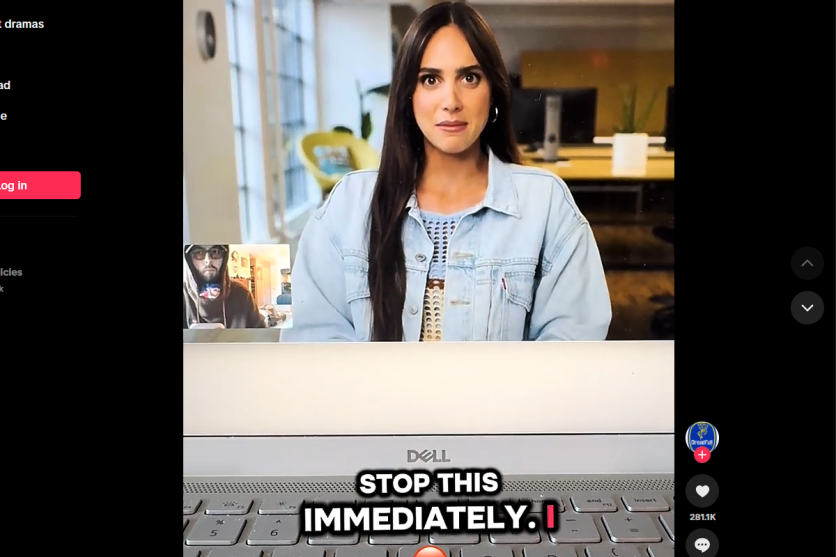
A fresh clip of an AI job interviewer appearing to malfunction has gone viral this week, after a candidate answered its questions in deliberate gibberish.
The avatar's expression shifted between a fixed smile and what viewers read as distress as it repeated fragments of speech. Commentators were quick to call it a meltdown, though the clip's own comment section is split on whether it is genuine or staged.
It is far from the first time this has happened. A study published on arXiv on 11 August 2026 is not research into job interviews itself, but it offers one of the clearest available windows into how a similar AI system behaves when placed in an interviewer role, and why at least some candidates are now treating that as an invitation to test it deliberately.
What Reddit Is Really Saying
Online, the reaction looks less like fear and more like a dare. Treat the interviewer like a system to be probed, not a person to be feared, and the clip stops being creepy and starts being a test.
One Reddit thread racked up thousands of upvotes, with commenters joking the AI needed to 'learn the correct language for the job.' A separate thread floated the theory that some of these clips are staged to make the technology look better, not worse, echoing our earlier coverage of an AI interviewer falling for the same trick.
That scepticism has some academic backing. Sriram Iyer and Tan Hong Ming, both business-school lecturers at the National University of Singapore, told Business Insider that similar viral clips are likely either doctored or represent rare, isolated incidents rather than a common phenomenon.
The more serious strand of the reaction concerns accessibility. One Reddit user asked what would happen to a candidate with a stutter or speech impediment, given the system's apparent inability to tell nonsense from a real answer.
That raises a more concrete question under the Equality Act 2010: whether an employer's AI-based selection process places a disabled candidate at a substantial disadvantage, and whether a reasonable adjustment, potentially including an alternative interview format, ought to be offered.
Government guidance for job seekers already flags this as something employers using AI are expected to consider, not something the AI itself is assumed to satisfy.
What the Research Found
Behind the memes sits a harder number, albeit from a different context: researchers at Pennsylvania State University coded 428 individual turns from 15 bot-led research interviews, studying an AI system built to conduct semi-structured interviews rather than recruitment screening.
The study found an AI interviewer that talks a great deal without listening much: just 4.9 per cent of its turns were genuine follow-up probes asking for more detail, while more than a quarter were bare acknowledgements, stock phrases such as 'that's really interesting,' repeated regardless of what had just been said.
The system had also been explicitly instructed to ask one question at a time. It ignored that instruction in 28.7 per cent of its question turns, stacking two or more questions together and leaving participants to answer only the first.
Researchers described the result as what they termed a 'bot effect': participants appeared to feel freer to disclose personal information to a machine, but gave shallower, less detailed answers once there was no human listening on the other end.
The paper frames this as a correlational pattern from a small practice study, not a controlled experiment establishing cause and effect.
The Wider Picture
The frustration is not confined to viral clips, though here the evidence is UK-specific. Research published by recruitment platform Greenhouse in May 2026 found 47 per cent of UK jobseekers have now been interviewed by AI.
Of those who had, 82 per cent said they were never clearly told beforehand that AI would be evaluating them. Thirty per cent reported walking away from a hiring process after discovering it involved an AI interview, a trend building even as demand for AI skills across the UK job market continues to climb.
For now, the viral clip offers a simple, if unverified, stress test for the technology: feed an AI interviewer nonsense, and see whether it notices.


