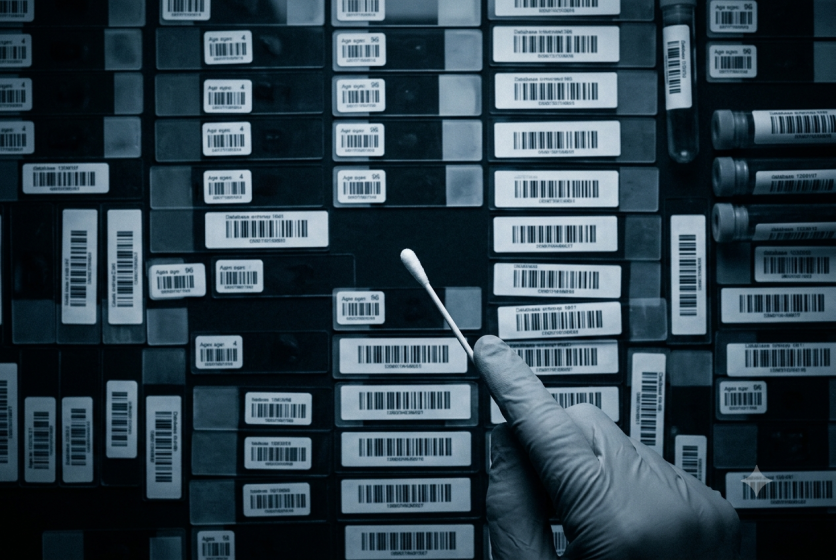
Investing tens of millions of dollars, the Trump administration has bolstered immigration agents' power to collect DNA samples from detainees, creating a system that has gathered genetic data from millions and stored it in a federal criminal database.
However, experts argue that the initiative, which enters legal territory untried by the courts, raises serious constitutional questions, with some fearing it could serve as a preview of a 'genetic panopticon' that expands government surveillance powers.
DNA Collection Has Surged Under Trump
US Immigration and Customs Enforcement (ICE) agents have collected DNA samples from detainees for years. However, the quantity of genetic files obtained by federal agents has grown dramatically under the second Trump administration.
A July study by Georgetown University Law School's Centre on Privacy and Technology found that ICE personnel obtained genetic material from up to 900,000 individuals over the past year.
According to the report, those genetic records are entered into a wide-ranging criminal justice database known as the Combined DNA Index System (CODIS). Operated by the FBI, the central archive contains genetic profiles submitted by local, state and federal law enforcement.
CODIS contained more than 3 million entries classified as 'detainee' profiles as of December. Separately, CBP records show that immigration authorities collected DNA from more than 133,000 children and teenagers—some aged just four—and hundreds of elderly people, including a 96-year-old.
Press reports have also pointed to cases of immigration officers collecting DNA from bystanders—such as legal observers and advocates—during field operations.
Millions Of Genetic Profiles Enter CODIS
Meanwhile, Homeland Security is expanding its authority to collect DNA samples from individuals in immigration custody. Official contracting paperwork made public on Monday reveals ICE spent an extra $10.1 million (£7.40 million) on 'rapid DNA tests', equipment and services designed to 'verify biological relatives' during field operations.
DNA Collection Raises Fourth Amendment Questions
The practice of gathering DNA from immigration detainees, a population largely accused of civil offences, raises constitutional questions involving the Fourth Amendment, which guards against warrantless searches and arbitrary state seizures.
Though specialists informed Courthouse News that legal limits govern how genetic data is obtained for standard policing, the rules are considerably more ambiguous in immigration matters, as federal judges are yet to rule on the constitutionality of ICE's bulk DNA sampling.
Immigration DNA Searches Face Untried Legal Limits
Existing legal standards allow officers to extract genetic profiles from suspects taken into custody with probable cause for major crimes. That rule stems from Maryland v. King (2013), in which the Supreme Court held that taking cheek swabs for DNA testing does not violate the Fourth Amendment's protection against unreasonable searches and seizures.
But Ric Simmons, a legal scholar and law professor at Moritz College of Law at The Ohio State University, pointed out that the court's decision did not apply to immigration enforcement.
Simmons observed that most of these civil immigration detainees had not committed a serious offense that would justify DNA searches. While the government may claim 'immigration exceptionalism' and 'special needs' to identify offenders, no court has confirmed whether this widespread collection respects the Fourth Amendment.
ICE Defends DNA Collection As Crime-Fighting Tool
ICE representatives maintain that gathering genetic material from detainees supports efforts to create a comprehensive national database.
You asked for results, we made the changes necessary for this FBI to deliver- one example, DNA:
— FBI Director Kash Patel (@FBIDirectorKash) August 21, 2026
We are statutorily required under the “DNA Fingerprint Act of 2005” to receive and process collected DNA samples from federally convicted offenders, arrestees, and non-U.S. citizen…
Furthermore, a 2025 email published in the Georgetown Law report reveals a chief ICE legal adviser stating the 'primary purpose' of the collection was forming a database 'for solving crimes.'


