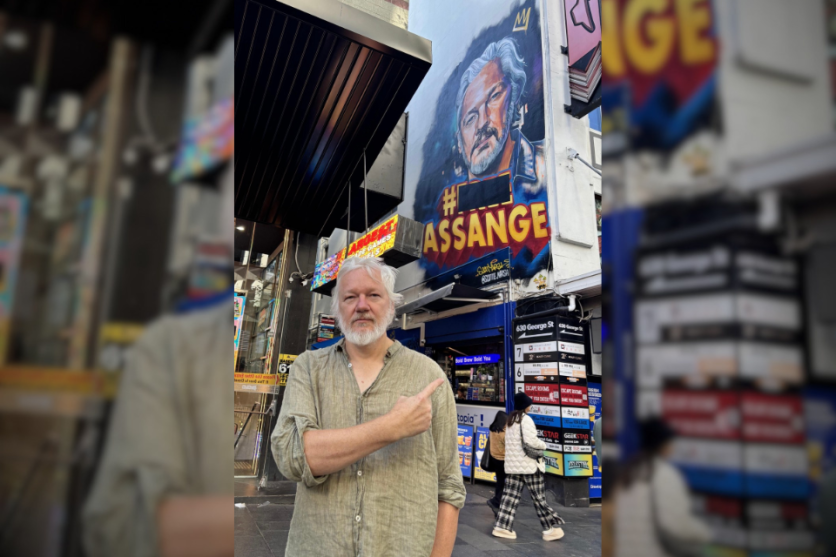
Julian Assange has returned to X with a two-word message: 'I'm back.' The WikiLeaks founder marked his return with a photo of himself standing in front of his own mural in Sydney, which drew viral engagement within hours.
The mural, painted by Australian street artist Scott 'Scottie' Marsh in July 2023, covers the side wall of 630 George Street in central Sydney. It depicts Assange beneath comic-book-style '#Assange' lettering, with the word 'Free' blacked out from the original '#FreeAssange' text.
The post marks a highly visible return to public life for Assange after an extended period of relative silence. His 14-year legal battle with the United States ended when he was released from a British prison in June 2024.
Within a few hours of the post going live, it had attracted more than 6 million views, thousands of shares and hundreds of comments.
Assange's Last Public Appearances
Assange did largely retreat from the public spotlight after returning to Australia, but describing the period as a two-year silence would be inaccurate.
In October 2024, four months after his release, he appeared before the Parliamentary Assembly of the Council of Europe in Strasbourg. It was his first public appearance since leaving Belmarsh.
'I pleaded guilty to journalism,' Assange told the hearing, describing his decision to accept the plea deal as a choice between freedom and what he called 'unrealisable justice'.
The following year, Assange was seen publicly in Sydney. In August 2025, he attended a major pro-Palestinian demonstration that crossed the Sydney Harbour Bridge. Reuters reported that Assange was among those taking part in the march.
I'm back. https://t.co/2e58azeJkt
— Julian Assange (@JulianAssange) September 17, 2026
The 17 September X post is therefore more of a return to social media activity than a return from a two-year disappearance from public life. Now, after years of legal battles and a quieter life in Australia, he has returned to X with just two words: 'I'm back.' What comes next remains unclear.
Who Is Julian Assange, and Why Did He Disappear?
Julian Paul Assange, 55, is the Australian founder of WikiLeaks, the publishing organisation that rose to global prominence after releasing large collections of classified US military and diplomatic material.
In 2010, WikiLeaks published hundreds of thousands of US military records and State Department diplomatic cables obtained from Army intelligence analyst Chelsea Manning. Among the material was a video from a 2007 US Apache helicopter attack in Baghdad that showed the deaths of more than 10 people, including two Reuters journalists.
The US government later charged Assange under the Espionage Act and with a computer-intrusion conspiracy. A superseding indictment filed in 2019 contained 18 counts. The Justice Department alleged that Assange conspired with Manning to obtain and disclose classified national defence information.
Assange spent seven years inside Ecuador's embassy in London after seeking asylum there in 2012. British police arrested him in April 2019 after Ecuador withdrew his asylum. He was then held at HM Prison Belmarsh while fighting extradition to the United States. The Justice Department says he spent 62 months in UK custody in connection with the US case.
How Assange Was Finally Released
The legal standoff ended in June 2024 through a plea agreement with the US Department of Justice.
Assange pleaded guilty to a single count of conspiring to obtain and disclose classified national-defence information. The plea was entered in the US District Court for the Northern Mariana Islands in Saipan on 26 June 2024.
The plea agreement brought the US criminal case to an end and allowed Assange to return to Australia.
In court, Assange acknowledged that he had encouraged Manning to provide classified information and said he had believed the First Amendment protected his conduct while accepting the guilty plea under the Espionage Act.
His lawyer Barry Pollack and Assange himself have continued to frame his actions in the context of journalism and publishing, while US prosecutors maintained that he participated in a criminal conspiracy to obtain and disclose classified national defence information.


