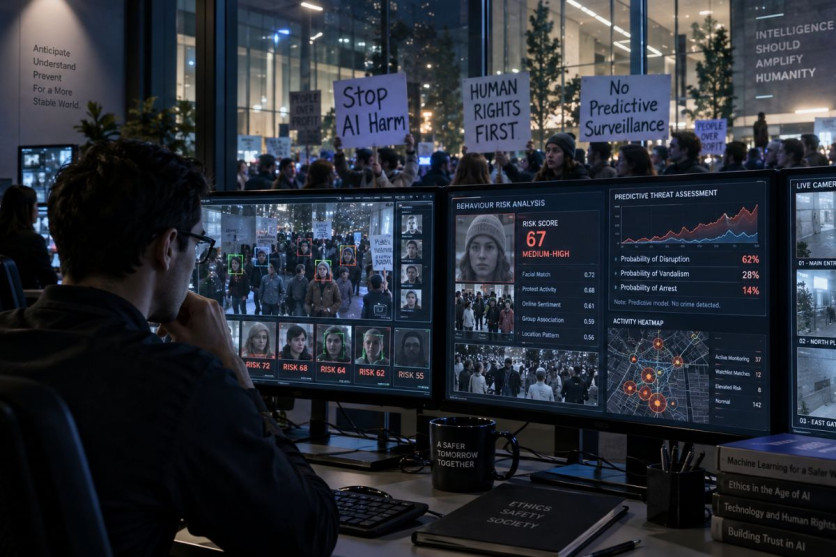
Anthropic advertised a corporate intelligence role in August that listed 'activism' among the global threats its security team may investigate. Separately, members of the company's security staff have spoken about moving towards a more proactive and predictive approach to threat monitoring.
The developments have attracted attention following comments from Anthropic CEO Dario Amodei, who said in August that negative attitudes towards artificial intelligence reflected what he described as 'fundamentally a crisis of trust'.
There is no evidence that Amodei was referring to Anthropic's corporate security operation when he made those remarks. Still, the developments raise a broader question for rapidly growing AI companies: how do they protect employees and executives while drawing a clear line between genuine security threats and legitimate protest or criticism?
Anthropic Job Listing Includes Activism Among Global Threats
An Enterprise Intelligence Specialist position advertised by Anthropic in August said the company's Global Safety, Intelligence, and Security team was responsible for protecting its employees, facilities and operations around the world.
According to the listing, the analyst would be expected to 'identify, assess, track, and investigate' a range of global threats. Those included geopolitical instability, terrorism, crime, activism and nation-state targeting of the AI sector.
The position also involved behaviour-based threat assessments, investigations and open-source intelligence gathering focused on specific threats, actors and events.
The wording does not mean Anthropic considers every activist, protester or critic of artificial intelligence a security threat. What it does show is that 'activism' is one of the categories its enterprise-intelligence team may examine when assessing risks to the company.
The American Prospect linked the recruitment effort to Anthropic's wider security operation and characterised the company's approach as 'predictive surveillance'. Anthropic did not respond to the publication's request for comment.
Anthropic Security Staff Described Early Warning Around Protest
The investigation also cited a 2025 discussion involving Anthropic security staff Keon Ellison and Zachary Melvin, alongside Samdesk Chief Executive James Neufeld.
Samdesk describes its platform as a real-time risk detection and situational awareness service designed to help organisations identify developing incidents and respond quickly.
During the discussion, Ellison recalled an incident involving an Anthropic executive who was visiting a major city. Samdesk alerted the company after organisers changed the timing of a planned protest.
According to Ellison, Anthropic received roughly 60 minutes' notice. That gave its security team enough time to alter the executive's route and direct the person through a service entrance rather than risk encountering the disruption.
An Anthropic security manager also described the broader goal as moving towards 'proactive and predictive and preventative threat engagement and management'.
The remarks indicate that Anthropic's security operation is seeking to identify potential incidents before they unfold, rather than responding only after something has happened.
They do not, however, show that Anthropic has a system capable of predicting who will commit crimes. Nor is there evidence from the discussion that individual participants in the protest were investigated or reported to police.
Anthropic's Usage Policy Restricts Certain Surveillance Uses
Anthropic's public Usage Policy adds another layer to the discussion.
The policy restricts customers from using Anthropic products and services for certain surveillance and law-enforcement purposes. Among other provisions, it prohibits using Anthropic products to track a person's physical location without consent and specifically identifies predictive policing as a prohibited use.
There is no evidence, however, that Claude or another Anthropic AI product was used to monitor the protest described by Ellison. The alert in that example came from Samdesk, a third-party risk-detection service.
That distinction matters. Based on the evidence currently available, neither the job listing nor the protest example demonstrates that Anthropic violated its own Usage Policy.
Anthropic's Transparency Hub also describes a separate Safeguards function that uses detection and monitoring to enforce company policies across its products and services. That work is distinct from the corporate-security and enterprise-intelligence operation described in the job listing and should not be treated as the same system.
Amodei's 'Crisis of Trust' Comment Was About AI Backlash
On 15 August, Amodei addressed negative public attitudes towards AI in a post on X.
'I think it is fundamentally a crisis of trust,' he wrote, arguing that many ordinary people distrust companies, governments and the technology industry.
His remarks came during a discussion about criticism of AI companies and whether warnings from industry leaders about artificial intelligence had contributed to growing public scepticism.
There is no evidence that the comments were about Anthropic's corporate security programme or the monitoring of protests.
Their timing does, however, place them within a wider debate facing the AI industry: how companies build public confidence while simultaneously expanding the security systems used to protect their employees, facilities and executives.
For now, the available evidence supports a more limited conclusion than descriptions such as 'pre-crime surveillance' might suggest.
Anthropic has advertised an intelligence role that explicitly lists activism among the categories of threats its analysts may investigate. Its security staff have also described using real-time information about a planned protest to alter an executive's movements, while discussing a broader shift towards more proactive and predictive threat management.
What remains unclear is how far those practices extend, what internal safeguards govern them and, crucially, how Anthropic distinguishes a legitimate security threat from peaceful or lawful protest activity.
Frequently Asked Questions
- What is Anthropic's approach to security threats?Anthropic's security team investigates global threats including activism, using proactive and predictive threat management.
- What did Anthropic's CEO say about AI trust issues?CEO Dario Amodei described negative attitudes towards AI as a 'crisis of trust'.
- Does Anthropic use its AI products for surveillance?Anthropic's Usage Policy restricts using its products for certain surveillance purposes, including predictive policing.


