Picture sitting in a room where artificial intelligence helps deliver the lessons and your physical stress is tested on the spot.
That is the reality reported for prospective students at Alpha School, a private K-12 school network in the US that uses personalised learning software to complete core academics in about two hours a day, while some prospective students reportedly wear heart-rate monitors during admissions trials.
Behind the high-efficiency promise lies a demanding process that reportedly forces young learners to keep their cool under intense pressure.
Benjamin Riley, an education policy writer and cognitive scientist, recently examined Alpha School, a private K-12 network in the US that relies on an artificial intelligence teaching platform alongside other unconventional features.
AI-Powered Learning Meets Extreme Admissions
Earning a spot at the private K-12 institution reportedly requires prospective high school students to complete an eight-week trial.
By tracking the social channels of current enrollees, Riley noted that the onboarding process felt less like a typical school welcome and more like a fraternity hazing experience, with candidates subjected to a series of unusual challenges just to make the final cut.
Aspiring enrollees must launch a fresh profile on X, secure at least 100 organic followers, purchase a subscription and reply regularly to accounts with substantial content, according to a student account shared by Riley.
As one student clarified in a captured exchange shared by Riley, empty remarks will result in rejection, while shortcuts such as purchasing followers or spamming trigger an instant disqualification.
'Great post' replies don't count, the anonymous student posted in a screenshot shared by Riley. 'Buying followers or spamming = automatic fail.'
Students Face Heart-Rate Tests Under Pressure
Beyond mandatory social media tasks, candidates face an unexpected physical test in which they wear live monitors in front of their classmates while watching a recording of their parents criticising them.
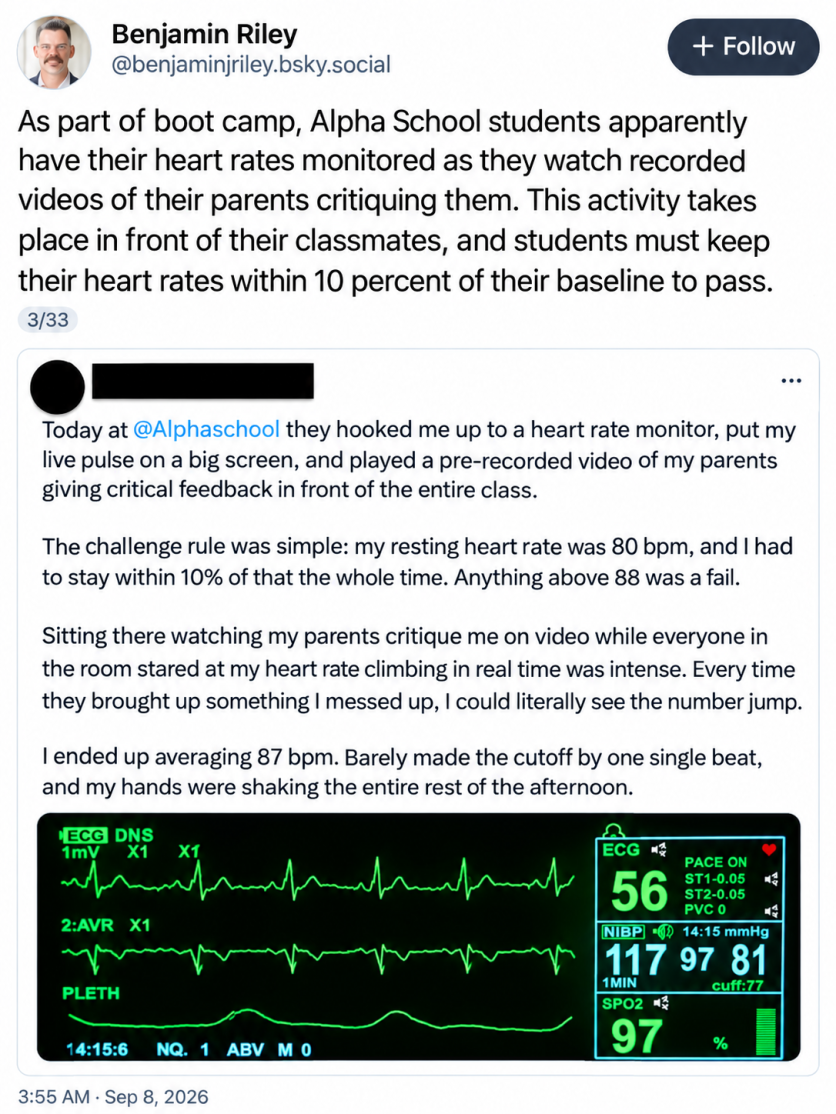
'The challenge rule was simple,' one student wrote: 'My resting heart rate was 80bpm, and I had to stay within 10 percent of that the whole time. Anything above 88 was a fail.'
While the exact pedagogical objective and the penalties for failing remain murky, one participant shared that the eight-week ordeal was meant to 'prove I deserve to be here.' Alpha School did not respond to requests for clarification.
'I ended up averaging 87bpm,' the student added, squeezing past the threshold by a single beat while enduring shaking hands for hours afterwards.
The AI School's Other Tests of Student Resilience
Riley also reported that Alpha School requires participants to perform uncompensated chores such as scrubbing petrol-station restrooms or restaurant kitchens as part of the admissions process.
Two attendees verified this requirement, noting that participants must film and narrate their work and that any expression of frustration triggers an immediate disqualification.
'We have to find and execute an unglamorous job with zero pay, whether that means mucking horse stalls, cleaning grease traps after closing, washing trash bins, or scrubbing gas station bathrooms,' one of the students explained.
Additional hurdles include completing an entire Advanced Placement unit in under five days without a teacher, using AI chatbots only, followed by an exam. Another teenager detailed a three-day wilderness survival trial in an unfamiliar area, equipped with nothing more than a tent and three bags of rice.
Alpha School Faces Questions Over Its Tech-Heavy Model
When Riley reached out for comment, Alpha School representatives raised concerns about the ethics of reporting on the 'social media activity of minor children' and asked that their identities be protected in any final coverage.
'We ask that you weigh the ethics of identifying minors in this way in your reporting, and we expect any published piece to protect their identities,' an Alpha School representative stated.
Alpha School's official website says its model uses an AI tutor to provide personalised, one-to-one education, while adults in the room support students with motivation and independent learning. The company says its core academic work is completed in about two hours, followed by time spent developing life skills and exploring other interests.
Weighing in on the controversy, educator and writer Audrey Watters criticised the institution's tech-heavy claims and argued that AI-driven instruction belongs in science fiction.
'Alpha School's promises have always been mostly snake oil: this idea that artificial intelligence can deliver high-speed, high-quality education is mostly the stuff of science fiction, not reality,' Watters noted.
'What we witness with Alpha School isn't a matter of simply ignoring the weatherman, fingers crossed, hoping that the sun will continue to shine on the chosen few and that the winds will shift again in industry's favor,' Watters added, referring to rising criticism of AI and the Silicon Valley ethos underlying Alpha School's mission. 'Rather, it's pretty clear that there's an absence of any moral compass at all.'


