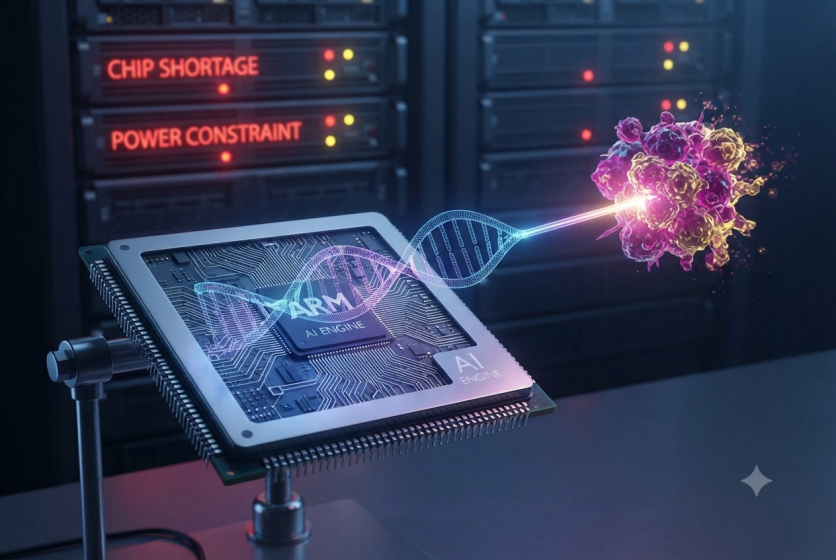
Artificial intelligence could achieve medical breakthroughs against cancer that exceed human capabilities within our lifetimes, according to the chief executive of British chip designer Arm Holdings.
Rene Haas, chief executive of Cambridge-based Arm, said modelling how a DNA marker is affected by cancer remains 'too complex' for today's technology, but he believes increasingly sophisticated computers will eventually be able to solve such problems.
Speaking to the BBC, Haas also predicted that humanoid robots could become part of everyday life within the next five years. However, he warned that the rapid expansion of data centres is facing severe component shortages and questioned whether building a large-scale domestic semiconductor manufacturing industry in the UK is realistic.
Arm's processor architectures power billions of devices worldwide, from smartphones and smartwatches to cars and other everyday electronics.
The company's valuation surged during the artificial intelligence boom, making it one of Britain's most valuable technology companies.
AI Could Solve Cancer Problems Beyond Human Capabilities
Haas, who is also a senior executive at SoftBank and a former AstraZeneca board member, said on the BBC's Big Boss Interview podcast that AI could eventually help find a cure for cancer that humans might not be able to discover within their lifetimes.
'AI is going to... find a cure for cancer that today you and I, other humans [could] not in our lifetimes,' Haas said. 'I believe in our lifetime, AI will help cure cancer.'
He acknowledged that modelling a cell, a human and the way a DNA marker is affected by cancer remains an extraordinarily complex challenge.
'Modelling a cell, modelling a human, modelling how a DNA marker is impacted by cancer - it's too complex a problem, not only for humans today, but the computers that run AI,' he said.
However, Haas argued that the situation could change as researchers feed increasingly sophisticated models and larger amounts of data into more powerful computers.
'Going forward, as we feed more and more of the models into these computers, and the computers get more sophisticated to run the models, they're going to solve it,' he said.
Professor Chris Bakal of the Institute of Cancer Research in London, who is also chief executive of Sentinal4D, said the discussion around AI in cancer research is increasingly shifting towards the quality of the data used to train these systems.
Personalised mRNA Cancer Treatment Shows Promise
That vision of data-driven cancer treatment is already being explored in clinical trials.
On 19 August 2026, Moderna and Merck announced positive topline results from the Phase 3 INTerpath-001 trial of intismeran autogene, an investigational personalised mRNA-based therapy, given in combination with Merck's Keytruda.
The trial enrolled 1,137 patients with completely resected stage IIB-IV melanoma, a form of skin cancer, who faced a significant risk of the disease returning.
Moderna and Merck said the combination produced statistically significant and clinically meaningful improvements in recurrence-free survival and distant metastasis-free survival compared with Keytruda alone.
The results do not mean that the treatment has cured melanoma. Instead, they provide encouraging evidence for the potential of personalised mRNA technology as a treatment for patients at high risk of their cancer returning or spreading.
The therapy is designed to target neoantigens associated with an individual patient's tumour, potentially allowing treatment to be tailored to the specific characteristics of their cancer.
Musk Calls Cancer Treatment a Software Problem
The results also prompted Elon Musk to argue that advances in mRNA technology could make treating diseases increasingly resemble a software problem.
Musk made the comments on X while responding to Eric Topol, a prominent physician-scientist and founder and director of the Scripps Research Translational Institute.
Despite its obvious misuse during Covid, mRNA has tremendous promise for curing diseases.
— Elon Musk (@elonmusk) August 19, 2026
Artificial RNA essentially makes curing diseases a software problem.
Topol highlighted the melanoma results alongside earlier research into personalised mRNA vaccines being investigated for cancers including pancreatic cancer, triple-negative breast cancer and non-small cell lung cancer.
The developments illustrate why AI and other advanced computational technologies are attracting growing interest in cancer research.
While Haas's prediction that AI will help cure cancer remains a vision for the future rather than an established medical outcome, researchers are already using increasingly sophisticated computational tools to analyse biological data and develop more personalised approaches to treatment.
Frequently Asked Questions
- What role does AI play in cancer research?AI is being used to model complex biological processes and develop personalized treatments, potentially leading to breakthroughs in cancer research.
- What are the challenges of using AI in cancer research?Challenges include the complexity of modeling biological systems and the need for high-quality data to train AI systems.
- What is personalized mRNA cancer treatment?It is a therapy designed to target neoantigens associated with an individual's tumor, allowing treatment to be tailored to the specific characteristics of their cancer.


