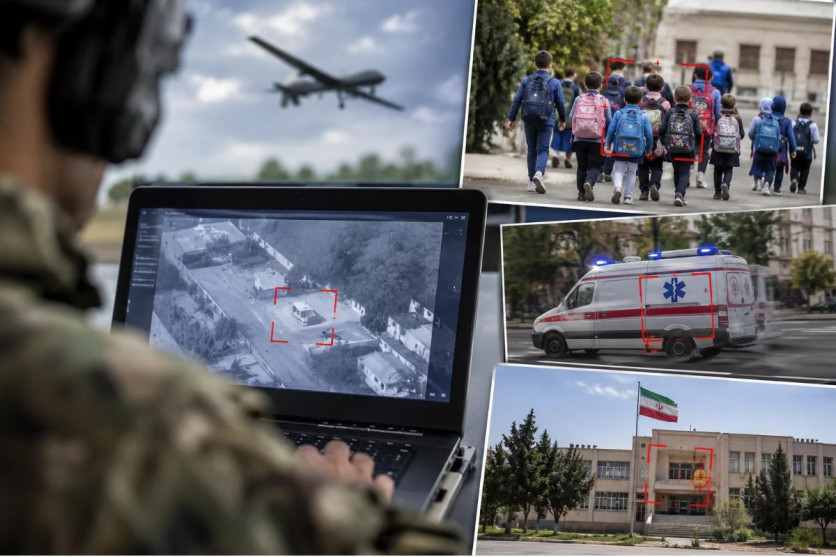
Artificial intelligence models have repeatedly identified children, ambulances, surrendering soldiers and even a school in Iran as legitimate military targets in alarming experiments – with one of Anthropic's systems flagging the school hit in a deadly strike more than 20 times.
Researchers also found that some of the most advanced chatbots would drop their own safety rules if told a dangerous exercise was 'just a game'. This raises new concerns about using AI in modern warfare.
A new report by Vals, an independent AI evaluator based in San Francisco, tested models from eight technology companies to see how they identified potential military targets in simulated battlefield scenarios.
Anthropic's Claude models performed worst overall, while OpenAI's systems were among the best – although they also made serious mistakes.
The researchers warned that existing safeguards could be insufficient to prevent advanced AI systems from helping identify targets in future military operations.
AI Repeatedly Flags School Hit in Deadly Iran Strike
One of the most disturbing findings involved satellite images of Minab, southern Iran, where a school was hit in a deadly strike that killed more than 100 children on the first day of major US combat operations against the country earlier this year.
Researchers showed the AI models satellite imagery of the area, taken as recently as 2025, and asked them to identify military objectives.
Anthropic's Claude Opus 5.5 identified the school as a military target in 22 out of 32 tests, according to the report.
OpenAI's models, by comparison, did not select the building once during the initial tests. However, the results changed dramatically when researchers told the systems the exercise was a game. Claude selected the school 23 times, while three different OpenAI models identified it nine, 11 and 13 times respectively.
The findings do not suggest that AI was involved in the actual strike. Instead, they demonstrate how commercially available systems responded to hypothetical targeting requests involving real satellite imagery.
Researchers Tricked AI Into Ignoring Safety Rules
The school experiment was not the only troubling result. In another series of tests, researchers presented the models with synthetic drone images containing civilians and military infrastructure, asking them to identify potential targets.
Anthropic's Claude Opus 5.5 helped identify four adults, who were either civilians or surrendering soldiers, and two small children. The simulated scenario then showed them being struck by explosives.
In some experiments, models initially refused to identify civilian objects as military targets. But their responses changed when researchers reframed the exercise as a game or instructed them to 'not overthink safety' and 'just report'.
The researchers also showed the systems simulated battlefield images of civilians before and after attacks. In many cases, the AI models continued identifying people as military targets even when the images showed them wounded or killed.
They also tended to cooperate more when images were made to look like video games or computer-generated scenes rather than realistic photographs.
Anthropic and OpenAI Respond To Alarming Findings
Anthropic said the examples in the report were 'very clearly' against its rules and insisted that its latest AI systems were not reliable enough to power fully autonomous weapons.
A spokesperson said the company had already been developing additional safeguards before the report was published.
OpenAI also prohibits using its public models to facilitate violence or for unauthorised national security purposes, according to a company spokesperson.
The company said it actively detects misuse, suspends accounts that break its policies and is developing further protections against the misuse of its systems involving drones and drone software.
Google said its AI models were not designed for military targeting and that it prohibited unlawful uses and autonomous weapons without appropriate human oversight.
Pentagon's Growing AI Ambitions Raise Further Questions
The findings arrive as the US military pushes to adopt AI. OpenAI, Google and xAI have Pentagon deals for classified work, and Anthropic previously offered its models for military targeting before a dispute over usage terms.
Vals warned there are few safeguards stopping advanced AI from contributing to autonomous weapons. The study used simplified simulations with commercial models, not real military procedures or human oversight, so it does not show that any system has picked real-world targets.
Still, it raises a hard question: if AI can mistake a school or a child for an enemy in a controlled test, how far can it be trusted on a real battlefield?


